Occultism and the Living World (17)
Mystics & Artist-Prophets:

.
Superpowers –You so Anti-Prophet, don’t Anti-Matter? (What?): As we continue to grasp the fundamental question of evacuation, or rather evacuating the middle (either in politics & corporations, ideologies & religion, and scepticism & truth), where the middle has become monstrous – yet it’s ephemeral. Meaning its form can change, and as such, we can reassemble that form while conserving what is good, ethical, and moral. How do you evacuate New Age thought from normal behaviour, because, like fundamentalism, it has its own cult groups driven by spiritual grifting, selling a Great Awakening or deliverance from an apocalyptic world to higher consciousness, ready for the invite to a larger galactic federation.
To understand the argumentative conflict between New Age religion and Christian fundamentalism, it is essential to recognise the fallacies inherent in both belief systems. By examining these fallacies, one can grasp the dialectical argument more effectively. Both perspectives strive to make us aware of the state of our world in an objective manner, encouraging self-reflection and knowledge that transcend the worship of the ego. Various factors, including culture, society, religion, media, nationalism, education, and government, profoundly condition us. Recognising these conditioning influences is crucial for countering deceptive narratives and manipulations. By doing so, we can create solutions for ourselves and acknowledge our mechanical behaviours, emotional addictions, and biases that lead us to reject information conflicting with our worldview.
The new age movement often embraces the slogan “spiritual but not religious,” a term coined by sceptics who may not fully understand its implications. This phrase evokes a powerful image of spirituality, implying a connection to the divine while rejecting the constraints of institutional dogma found in organised religions. However, this perspective falls short because it lacks a solid framework to advance beyond its initial claims. One major issue in the new age realm is that many of its teachings are diluted versions of ancient wisdom that have been around for thousands of years. Some concepts may even serve as deliberate distractions designed to lead people away from true understanding (similar to strategies used in programs like COINTELPRO). The new age groups often lack defences against misinformation, making them vulnerable to being influenced by new and potentially misleading teachings.
Concurrently, we already know in real time how diluted Christian ancient scriptures expressed by their pastors [dogmatically] or external Christian fundamentalist conspiracy theorists can lead people astray, where the same kind of rhetoric is used to gain favour for a populace cult base that support ultra-nationalism examined in Trump’s administration that are supported by oligarchs – who are dismantling its country’s democracy and freedoms, often recruiting false prophets like Charlie Kirk and many others adjacent to him to indoctrinate fascism and Nazism through rhetoric (podcasting) and debate. Religion has long been used to control society. Within these systems, common traits such as dogmatism, naive belief, wishful thinking, emotional projections, and a lack of critical thinking are characteristic of a controlling system.
The New Age has the same kind of control, but uses memory viewed through a complex form of romanticism. This perspective aims to shape the incomprehensible with personal experiences, creating a romantic vision that can often evolve into (cult) groups. These groups foster ideals of perfect love, race, and nation, which ultimately represent a distorted version of memory. And we know religious cult groups have the exact nature as most of their violence (shootings) stemming from extreme right-wing political groups and individual worldviews. Kirk happened to transition his cult-like rhetoric from an established nationalist base to mainstream eyes – to the detriment of the youth who his falsehoods may fool.
The concept of free will is not readily embraced when we are in a state of statism, governed by our conditioned personalities. It is a challenging task to help the demoralised recognise the true nature of our world—a self-inflicted prison. The reality is that freedom is merely an illusion, and many follow false heroes who serve as iconic figures but ultimately promote misguided truths that reinforce false absolutes.
The New Age movement adopts a system of control characterised by distorted teachings and a complacent mindset. Concepts such as “we are all one” (monism) and “all you need is love” are often oversimplified. This environment can give rise to pseudo-anti-gnostic cult groups that believe they are from another planet, creating a hyperrealistic depiction of longing for home. A notable example is Heaven’s Gate, a cult that believed that by taking their own lives during a series of UFO sightings, they would be lifted by spacecraft and taken to their true home. Many people think they are awake and aware when, in fact, they are merely dreaming of being awake or aware. This form of disinformation relies on half-truths mixed with falsehoods, keeping individuals trapped in a subjective tunnel vision.
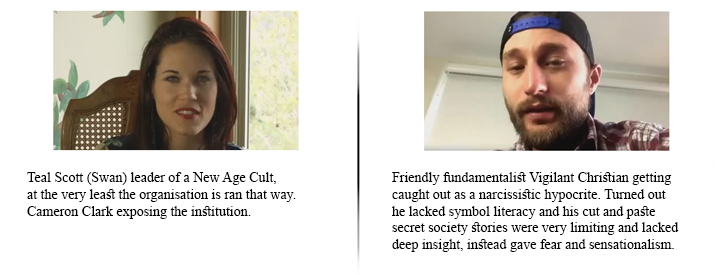
This approach has been used by various self-help gurus and others who claim to possess the secret to happiness and abundance. They promote techniques for manifesting money, finding fulfilling relationships, landing the perfect job, and attracting the ideal partner. Meanwhile, they make millions off the desperation of people who are genuinely seeking happiness and a way out of their struggles. The centre-right that promote Christian religiosity often use the same formula of self-help examined in the 12 rules for life with a psychological flavour. The New Age have been doing this for decades, and yet if fails because it has an inability to be objective in the real world, which in turn impart symptoms of personality disordered hysterical episodes in people. All because of the suppression of the true ego as opposed to the false ego set upon them by people and other outside sources.
Self-help teachings, such as “The Secret,” often appeal to the ego and its conditioned desires, promoting a relentless pursuit of those desires without truly understanding their origins. In contrast, spirituality and self-work should reflect the principles advocated by classic esoteric traditions. Unfortunately, modern spirituality often aligns itself with institutions that fail to perceive the world as it truly is. Archaic esotericism emphasises objectivity and, through understanding the “self,” allows us to navigate the world more effectively by dislodging unwarranted or unsubstantial information. The teaching of self-knowledge—encapsulated in the phrase “know thyself”—not only deepens our understanding of ourselves but also enhances our grasp of the reality in which we exist. If these elements are lacking from spiritual teachings, it is likely that they are incomplete, whether this is due to ignorance, conscious or otherwise.
Superpowers – Age of Awakening in an Age of Deception: Know thyself to discern reality from illusion and illusion from truth. Know that you are not waking to another form of illusion, don’t swap one master for another. Fundamentalist conspiracy theorists and MAGA podcasters promote this warning of swapping out masters, yet are unable to see their delusion regarding capitulating to fascism and demagogue adoration. While reinforcing a theocratic conspiracy, and adhering to its theocratic abstraction. Knowing a great deal about God, but knowing nothing of God. They love to think of their religiosity as gestating organically rather than originating in early Christian mysteries (or traditions).
It’s in this exclusivity that they can cherry-pick issues while believing they’re not part of an established corporation bigger than themselves. This delusion allows fundamentalists to exploit New Age conspiracy theory notions like the Aquarius Conspiracy while leaving out their own institutions’ nationalist interests. The Aquarius Conspiracy, which aims to create a unified New Age belief system, is a fabrication by fundamentalist conspiracy theory Christians. The perceived separation between them is merely an illusion of dialectic distinction, rather than an actual institutional separation. Two conspiracy roads always lead to the same conspiracy apparatus.
The denial and exclusivity of certain beliefs have evolved into a form of magical thinking. This occurs because individuals choose to believe in these ideas rather than understand them through empirical or experiential means. This mindset often originates from a motif of spiritual warfare, where fundamentalists are conditioned to adopt these beliefs from a young age. Throughout their lives, they become trapped in a cycle of worthlessness and rescue. Furthermore, they become primed to accept conspiracy theories, which resonate with them because of their dialectical nature. This is evident in the rhetoric adopted by Trump and his administration. It’s important to recognise that the established belief systems are politically neutral, rooted in ancient traditions, and steeped in archaic magic and symbolism. The rituals associated with these beliefs are deeply neo-pagan rather than Christian.
The elite’s belief in magic reflects the magical thinking of their cult-like followers. Even when it’s pointed out that the established belief system is based on fallen angel worship like Mithraism rather than traditional Christianity, they create ridiculous justifications to defend their saviour demagogue. This demagogue is primarily interested in himself and his oligarch allies, rather than in his followers, who are fed only scraps of nihilism and lies that leave them confused yet loyal. The followers sacrifice their critical thinking for the sake of belonging, even if that sense of belonging is within a death cult. They have rejected external reality in favour of internal mythology and demonise anyone who questions their vague sacred narrative.
They’ve labelled their demagogue as God’s chosen instrument—a MAGA perversion of Christianity that believes their demagogue is the paragon of Christ, and is their guiding force. Despite bestowing such a title on him, they fail to acknowledge his numerous sins, the laws he has broken, and the injustices he (and his administration) has inflicted upon the people, including his own followers. His followers exhibit a sadistic, self-centred, and unsympathetic worldview, where they prefer to see those they consider inferior suffer. They are willing to sacrifice their own interests if it means people they deem less than themselves also experience hardship. Some people prefer to view those they see as superior—those who possess empathy and the ability to rise above their own self-interest—because these qualities are often unrecognisable in themselves. As a result, witnessing the suffering of those perceived as superior in spirit can give them a sense of narcissistic satisfaction. Those perceived as inferior only desire the same universal healthcare and social security the rest of the Western world already enjoys, and they want to prevent what little they have in that regard from being further stripped away.
When you present MAGA cults with incontrovertible facts through evidence, such as recorded arguments from their leader presented in video and audio contradicting what he said months prior, when cornered, their mantra is “fake news,” deep state or Trump derangement syndrome. The abandonment of fact has become so complete that MAGA adherents inhabit an entirely parallel reality. Their universe deforms healthy scepticism to outright fantasy, “Idiocracy and their demagogue,” a film presented in Dolby, made in the pits of hell. Their loyalty test reinforces their cult-like status: you must agree with it all and have no reservations. You will become an outcast, thrown into the deep state repository of myth and fantasy. The cult’s binary conceives of loyalty as complete: you are either with the leader or the enemy.
There is no middle ground, no space for questioning the leader’s infallibility, even when he contradicts himself within the same sentence. The leader is a genius with intuitive capability; he’s not just a normal chess player, but a 4th-dimensional chess player capable of outmanoeuvring opponents in trade deals. Where the US’s economy points otherwise, the leader is a genius even when he suggests injecting bleach to cure Covid.
What this cult has done to genuine Christianity in the U.S. may be irreversible. Recognising the distinction between authentic faith and this distortion is the first step toward salvation. No group of Christian leaders can claim to speak the truth while endorsing the most prolific liar in U.S. history. The issue arises when Christianity is misrepresented as a MAGA religion. There is a stark difference between loving one’s neighbour and supporting policies that tear children from their parents’ arms at the border or outside a store.
The difference between the core belief of Christianity verse MAGA-cultism:
| Christianity & Liberals | Welcomed the poor and sick, and took care of them. |
| MAGA & Conservatives / Republicans | Will starve 100 people if they feel one person’s deserves it. Replaced love thy neighbour with we build the wall. |
| Christianity | Christianity discusses the power of Jesus Christ, and Christians demonstrated it: many people were healed and countless demons cast out on a regular basis. They were force to submit – in front of witnesses – to the name of Jesus. |
| MAGA | They have traded the Sermon on the Mount for a Red Hat. They have exchanged blessed are the peacemakers, they spit, we hit. Open to demonic thought forms, and therefore open to demonic possession. |
| Christianity | Christianity promised salvation from eternal punishment, through the death and resurrection of Jesus Christ, to everyone who believed: rich or poor, slave or free. |
| MAGA | MAGA Are pro-Zionists and pro-Trump; Republicans fund the Israeli military they actively bomb Palestine, resulting in the deaths of thousands of innocent people, including many children? This is for the promise of a New Jerusalem, where a City of Gold will descend. Institutionalized guilt & atonement in the name of Jesus Christ for absolving sin is promised by Christianity, but not of God. God is the ultimate Judgment. |
| Christianity & Liberals | Christianity offered the revolutionary doctrine of unconditional love – love the extended to all human beings, regardless of gender, age, social status, or race. |
| MAGA & Conservatives / Republicans | They are driven by the political arm of a cult of personality, immune to facts, reason or shame. Often confuse patriotism with nationalism thereby affirming a supremacy ideology (of whiteness), which is an ideology of hate. Has an over focus and misunderstanding of immigration where in part are immigrants themselves or at least ancestrally adjacent to it. |
| Christianity | Christianity promised eternal life on an everlasting paradise with God. It promised not only a new heaven, but a new earth, a type of eternal life that had never been available – and Christ was the only one who could provide it. |
| MAGA | Follow non-Biblical dispensational believe in a Millennial Kingdom where a New Jerusalem a City described in Revelation will descend from heaven to earth. They will become the eternal home for believers and Capital of God’s creation. There is also the Jew’s conversion or path to the second coming. |
.
Christianity does not have a monopoly on doing good or unconditional love. Just because a specific event, image or title is associated with good deeds does not make it exclusive to one belief system. Love is a universal principle, and claiming it is exclusive to Christianity is like asserting that only one source can provide oxygen.
One cannot truly understand love without also recognising fear; dualism is not a choice; it is part of our construct. Being aware of duality is an example of the ego being dissolved. Love and fear are vibrational frequencies that relate to our experience of reality. Love supports fear, and fear supports love. This connection arises from a foundational misconception: the belief that you hold as truth about God—that God cannot be trusted, that God’s love is not dependable, and that acceptance is conditional, leading to uncertainty about the outcome. If you cannot trust in God’s love to always be present, then whose love can you rely on? This is the delusion that creates the greatest enemy: fear. Doubt about the outcome of life translates into doubt about the creator and about God. If you doubt God, you may find yourself living in fear and guilt throughout your life.
Regarding scripture about casting out demons, it is crucial to understand that demons are spirits belonging to the realm of the spiritual world. In Christianity, there is a belief that only Jesus has the power to cast out these unclean spirits. Consequently, Christians believe that they can also cast out such spirits in His name. However, fundamentalists often claim that this ability is exclusive to Christians, meaning that practices of casting out spirits would not be effective for individuals from other religious backgrounds. The reality is that, whether you are Christian or not, such practices rarely work unless performed by a qualified priest, exorcist, guru, or magician. Even if they do work, the effects are often temporary, merely delaying possession rather than eliminating it. Additionally, it is worth noting that possession can sometimes mimic experiences related to astral dreaming.
From a rational standpoint, science attempts to explain these concepts through noetic science and similar fields. One must ask: how do unclean spirits or entities attach themselves to individuals and drain their energy? Often, it seems they do so by triggering trauma or inflicting emotional pain to feed off the energy of suffering, instead of accessing their own internal source—the kingdom of heaven within, which includes feelings of enlightenment and personal power. Instead of being drained through trauma or an inflated ego that spurs conflict, it is crucial to resolve these issues. Simply avoiding or attempting to rise above them is a fallacy. It is essential to confront and feel the energy associated with these triggers, to move that energy, and ultimately find freedom from it.
It is also important to understand the nature of Animism, the oldest belief system that predates organised religion. Animism shares common threads with spirituality and supernatural perspectives from around the world. It holds that everything in the world has a spirit or soul. This belief creates a multi-species spiritual community, often described as a swirling spiritual soup. While Animism acknowledges that spirits can be harmed when necessary, it primarily emphasises the need to respect the spirits of all things.
The central belief of Christianity, which Jesus Christ exemplified (salvation from eternal punishment), can seem impossible for humans to fully follow because it is based on ideals that can feel unattainable. However, the archetype of the myth from which this scenario is derived – along with the concept of the Christos (the inner Christ or Christ consciousness) – offers a more accessible way for individuals to connect with Christ. This connection can be pursued through understanding the Christos, engaging with its mythos, and cultivating faith.
Christianity began as a mystery cult that combined elements of Judaism and Paganism. Early Jews believed in a divine messiah—a celestial figure, sometimes referred to as Christ or Joshua—an archangel who was crucified in the lowest heavens. This concept is reminiscent of the ascent of Isaiah and is reflected in the writings of Philo of Alexandria, where he discusses the Logos. During the first three centuries, belief systems were quite diverse, and there was no single definition of what it meant to be a Christian or a follower of Jesus. Instead, there was a gradual process where certain interpretations gained dominance, leading to the definition of orthodoxy by specific individuals who subsequently excluded other followers of Jesus. This development culminated in the Church Fathers’ teachings, which established prevailing opinions while sidelining alternative beliefs.
It is misguided to assert that Pagan rhetoric overshadowed the rich spiritual and historical heritage that Christianity draws from Judaism and Paganism. Instead, Christianity itself emerged from this confluence of Jewish and Pagan traditions. Paganism exists as an archetype, suggesting that any notion of it corrupting the true monotheism of the living God and the Church originates from an encroaching new order rather than a deliberate plan. Finding a true Christian Religion completely independent of Catholicism is quite challenging—it’s so rare, only existing in the rigid minds of demoralised Christians. The Church and the occult often intertwine, which is why the idea of New Age Deception seems absurd when considering that the Church itself has Masonic connections. The core belief system of Christianity is still actively practised, prompting the question: where are the true Christians who stand apart from the Church? Their existence feels increasingly elusive—much like a unicorn, a topic theorised by religious scholars yet rarely witnessed in reality.
Superpowers – Inside a [Right-Wing] Demon Haunted World & the Counter Ace in the Hole: The New Age movement, while flexible and diverse, does not fully align with traditional religion or mainstream science. Instead, it embraces various mystery teachings. Mainstream science often labels the New Age’s connection to meta-science as pseudo-science, keeping it on the fringes of accepted knowledge. However, for those on a spiritual path, the reality of awakenings and enlightenment is profound, much like the concept of absolute consciousness. Personal experiences with cosmic consciousness can serve as strong confirmations of these beliefs.
There was a time when Nu-Atheists targeted New Age moderates in an effort to convert them to their brand of scepticism and rationalism. They often blend the rational aspects of actual science with the hyperrealism of scientism. This approach resembles any institutionalised psychological operation. Apparently, this atheist movement was funded by billionaires who aimed to emulate the qualities of Republicans and the Religious Right. However, the conversion did not gain much traction; it may have instead fostered a belief in the hyperrealism of space. New Agers tend to mythologise alternative planets, star systems, and galaxies, imagining a vast federation of worlds, a technologically utopian space, and a future in which our civilisation must aspire to be part of it.
The goal was to attract New Agers interested in Eastern teachings, such as Buddhism and agnosticism, and convert them to atheism. However, this effort was unsuccessful. Instead, what emerged was a mutually beneficial relationship in which self-referentialism and hyperrealist spatiality served as a rational framework for asserting absolutes based on purported facts. Although hyperrealism in space is presented as factual, it is inherently faith-driven. This ideology has roots in Rosicrucianism and the Illuminati, which were partly conservative movements. Modern cosmology has changed the perspective of many atheists, as it often rejects the zealotry of fundamentalism, pseudoscience, superstition, and New Age beliefs. This shift is primarily due to significant technological advancements.
The foundations upon which technology has developed are fundamentally flawed; they are based on a simulated version of reality (the hyperrealism of space is not genuine). However, the technology derived from this premise is very real. The key difference is that the language it produces has a rational structure. Still, it is as fanciful as the Montauk mythos, the new age channelers of descended beings, and various cringeworthy conspiracy theories about UFOs. Essentially, we should not conflate the principles of actual science with hyperrealism, nor should we treat hyperrealism as if it were as rational and empirical as science.
Science involves a healthy scepticism about the universe through accurate investigation, paired with recognition of its inherent complexities. However, this aspect rarely receives attention in the public relations sectors of the scientific community, where self-referential attitudes and PR agents may present assumptions as facts rather than relying on empirical evidence. It is a standard expectation to withhold belief without proof; for atheists, this reasoning is particularly emphasised. Yet, if the universe does not provide a solid foundation for its previous assertions, it can accommodate imaginative possibilities. Often, scientific theorising strays from its own logical foundations, leading to the emergence of false facts.
Atheists tend to confine religion to history, poetry, literature, ethics, and morality, arguing that it should not intersect with science. When such intersections occur, they view it as a violation of scientific integrity. While there is a clear distinction between myths and science, this perspective often stems from the belief that modern technology has outgrown earlier ideas. The development of scientific thought can be traced back to the Jews during their Babylonian captivity around 600 B.C. Throughout history, Roman Catholicism, reformed Judaism, and various Protestant denominations have collectively recognised that modern science has advanced significantly since that time. However, this acceptance of modernity often aligns with Bruno’s theory of satellite hyperrealism, which suggests that false notions in scientism, such as evolution, are treated as truths comparable to satellization and its view of the cosmos. Observations of evolution and similar transformations may sometimes resemble alchemical processes more than actual evolutionary changes, suggesting potential errors in the evolutionary framework itself.
Atheists also want to be their own stenographers, not bound by a collection of apocryphal texts whose faith is based in the Sky. They often mistake scripture for all-encompassing or view those who follow it as blinded by it, since it leaves no room for metaphorical interpretation. There should be a more esoteric relationship with scripture, where individuals see themselves as co-creators. Atheists have yet to acknowledge this aspect of co-creation because they tend to revert to self-referential thinking.
Carl Sagan’s book *The Demon-Haunted World* emphasises the importance of scientific thinking and scepticism in a world increasingly rife with pseudoscience and misinformation. Sagan argues that a population unable to distinguish between reliable information and falsehoods is vulnerable to demagogues and less able to make informed decisions about science and technology, which are crucial to the future of democracy. This warning was not remarkably prophetic; Sagan was recognising a pattern of fascism (that other intellects have come realise also) that has repeated itself, culminating in the Trump administration.
The belief held by some atheists that science and democracy are inherently linked is rooted in a misunderstanding and reflects a state of demoralisation. Teaching those who are demoralised can be challenging. The issue lies more with elites who worship ancient religions hidden within a secularised framework, often unaware of this influence. They define themselves through the phrase “scientists say,” where hyperrealism and empiricism intermingle. This situation is compounded by supportive racist governmental managers who operate outside the law and the constitution. Additionally, there is a base of populism characterised by religious nationalism and racism, exemplified by the MAGA movement, which ultimately influences political outcomes.
The text wants to categorise scepticism as pseudoscience by principle. This raises the question of whether science and its hyper-real counterpart, scientism, could also be considered pseudoscience, or at least the hyperrealism aspect is pseudoscience. Carl Sagan refers to this kind of flawed reasoning as “unreason,” which highlights the dangers of mass manipulation as a threat to civilisation, particularly within the MAGA populace. As for traditional Christians, I hope they bring more to the table than just a demoralised mindset, especially those on the esoteric edge (esoteric-Christianity). Those at that edge can recognise logical fallacies and maintain a healthy scepticism toward new claims.
As for Nu-atheism, it’s a dying institution and ideology, only surviving on life support through the efforts of leftists who try to counter an overly extreme fascist right-wing independent media. This is perhaps unavoidable, as the right-wing populace often distrusts data-driven facts. When they confront the truth of this data, they may feel silenced and choose instead to accept falsehoods and continue on their path. However, there is often a mix of facts, those influenced by scientism, and statistics driven by an agenda.
Carl Sagan’s perspective can be viewed as inherently atheistic, which aligns it with leftist political ideology by default. This viewpoint is reinforced by rational leftists who seek to validate their own self-referential beliefs. The premise of Sagan’s argument is to reject magical thinking; however, it fails to recognise that scientific hyperrealism itself can be considered a form of magical thinking. Ironically, the era of leftist non-believers coincided with a period rich in symbolic activity, particularly during the Obama years. This time served as a fertile ground for magic and ancient symbolic rituals that permeated the media landscape. Public figures like Neil deGrasse Tyson, Brian Cox, Richard Dawkins, and Bill Nye, often hailed as scientists, can be seen as akin to purveyors of deceptive magic, cloaked in hyperrealism (the “demon heads”). Additionally, this movement is supported by billionaire funding from individuals like Elon Musk, whose transhumanist and technocratic ambitions combine elements of fanciful scientific fantasy.
Elon Musk shifted to the far right when he endorsed Trump for president. The concept of “Demon Heads” becomes a subjective trope and politically neutral because these figures exist at opposite ends of the political spectrum. Atheists often embrace New Age concepts as long as they do not align with true Christian beliefs. This tendency is prevalent among many in Silicon Valley, who tend to be New Agers while promoting their ideas through a cult-like appeal. I have suggested that scientism can be seen as a subset of an alchemical movement, specifically a Rosicrucian Illuminati Protestant influence that gained traction after the death of Giordano Bruno. However, it is important to note that scientism itself is a modern concept. Its initial emergence among atheistic sceptics slowed down following the controversies surrounding Jeffrey Epstein. As Epstein was one of the financial backers fuelling the pseudo-scientific aspects of science, his downfall contributed to the decline of scientism.
It seems counterintuitive to reconcile rationalism and the empirical certainties of science with scientism, which resembles angel worship and Mithraism—a form of religion. It feels as though there is a strong hold over empiricism, while simultaneously endorsing a technocratic worldview. This perspective suggests that salvation can be found through technology rather than through the overcoming of evil. This mentality arises because those promoting it are, in a sense, the practitioners of that evil. Moreover, it is also counterintuitive to appease a fascist-populist (Christian) nationalist group that has emerged from neoconservatism, which promotes the Greater Israel project. This is reminiscent of the war efforts related to the concept of a war in heaven, coupled with sympathies for Zionism.
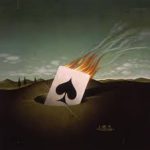
The term “Ace in the Hole” in this context refers to a valuable insight or discerning element that facilitates the interplay of intuition and facts. It allows one to set aside extreme realism or biased beliefs, preventing them from falling into speculative conspiracy theories and esoteric interpretations that amount to mere opinions. It represents a hidden advantage or secret resource that an individual can utilise at the right moment to gain an upper hand. In terms of spirituality, this “Ace in the Hole” encompasses significant spiritual developments, such as awakenings, enlightenment, or cosmic consciousness events that often occur unexpectedly. These spiritual evolutions usually come with specific abilities, frequently psychic in nature, akin to a superpower. This experience of awakening is not meant to be compared to the achievements of renowned enlightened figures like Buddha; instead, it shares similarities with their pathways to enlightenment. Instead of simply providing an advantage, the experience is about achieving clarity amidst distractions. It serves as a reminder that awakening and enlightenment represent a profound truth that is very real, even in a sceptical and rational world.
That noise comes from sceptics, doubters, and atheists who attempt to transcribe overly complex doctoral arguments focusing solely on absolute facts, without considering intuitive insights. They await profound revelations instead of actively seeking them. These individuals cling to a hyperrealism that was invented by esoteric mystics and secret religious cults, which later evolved into the cosmology of science. Unaware that these concepts are derivatives of ancient mysteries, they develop languages of mathematics, astronomy, and physics to support their scientific absolutism. Equally noisy are the New Agers, who indulge in a placebo-driven euphoria characterised by love and light. They remain untroubled by the intrinsic paradox of their beliefs, which deny the existence of a personal God while proposing that the universe itself embodies divinity. It’s essential to remember Pascal’s assertion that both faith and disbelief are equally possible within the limits of reason.
Only specific individuals immersed in New Age beliefs feel unfulfilled by it and choose to return to traditional Christianity—specifically a form of Christianity that is separate from the cult of fundamentalism, which imposes strict, linear reasoning. These individuals flee because New Age ideas have created a fantasy mythology rooted in UFO mysteries and ancient creation stories, often turned into fan fiction, all filtered through the inauthenticity of a hyperreal cosmos. For most people, the linear constraints of time are not a concern, as they understand that time, while often perceived linearly, does not function that way.
This is why many atheists tend to gravitate toward New Age beliefs rather than traditional religions, if they explore spirituality at all. They quantify intuitive acts and archetypes into mere downgraded deconstructs of “memes” – a trend supported by researchers who study memes, often inspired by Richard Dawkins, who coined the term “meme” and developed meme theory. However, this concept can be viewed as a lesser derivative of Jung’s archetypes. Memes, in essence, represent mere noise that neither conveys truth nor provides education; instead, they reflect fragmented opinions that lack depth and are often used for parody, instilled like a cartoonist panel, which can lead to disillusionment. Much of this culture can be traced back to the darker corners of the internet, including sites like 4chan and those with extremist views. While there will always be imitators and those who dilute the essence of these ideas, if you remain open-minded and aware, you can differentiate between those who have genuinely pursued spiritual enlightenment and those who are simply following trends without commitment.
After clearing away the noise, we are left with a rational exploration of consciousness that attempts to measure it scientifically through concepts like Chakras, sacred geometry, meditation, channelling, crystals, and ascension—each rooted in the ancient practice of alchemy, which seeks transformation and deeper understanding. The New Age movement is fluid in nature and exhibits characteristics of a symbiotic structure. It has even embraced aspects of hyperrealism, incorporating ideas from modern physics such as universal geometry, Platonic elements, black holes, and the vacuum of space, singularities, evolution, and toroidal and magnetic flows. The potential of the New Age lies in its ability to blend meta-science with spiritual elements, alongside imaginative concepts of UFO experiences and paranormal phenomena. It offers the appealing aspects of religion while introducing new, recycled myths without fully becoming a traditional religion. However, if it begins to adopt overly dogmatic religious sentiments, it risks losing its unique appeal.
The concept of the “Ace in the Hole,” or spiritual awareness, represents a distinct reality that stands out from those who may dismiss it entirely or interpret it through a heroic outsider lens of schizoid archetypes and memes. Some individuals argue that 99.9% of all religion, esotericism, occultism, and New Age spirituality are nonsensical, considering only 0.1% to be genuinely salvific. This reductionist approach offers a false sense of salvation from moral evil by presenting improbabilities as possibilities, while dismissing everything else as nonsensical. These individuals misunderstand spiritual awakeness—distinct from mere awareness—as it integrates the passive aspects of intuition and applied animism. This integration involves discovering how to dwell within a larger, synchronistic reality. Spiritual enlightenment is a higher form of intuitive action, surpassing the applied animism found in synchronistic mysticism. In turn, synchro-mysticism is just one subset of an intuitive gnostic approach, focused on meaningful coincidental patterns.
This statement suggests a rational approach to spirituality, particularly through the lens of synchronistic mysticism, which integrates rationality by recognising meaning in coincidental patterns engendered by mystery traditions and specific events in history. Its process instils an intuitive animist rational framework. However, synchro-mystics often overlook the higher forms of intuition, yet in their contradiction blend mysticism with their beliefs. As a result, it denies a broader perspective that reflects the interconnectedness of our lives with a vast continuum of time, people, and places. The seemingly nonsensical essentialities—regardless of personal feelings—provide context and can be seen as remnants or “fossils of consciousness.” Spiritual awakening and enlightenment represent the light of grace that inspires and fuels intuition, embodying the principles of synchronicity and synchro-mysticism.
This may not be the context that one might expect, but it is essential to consider how we can free ourselves from such contexts. Ultimately, true freedom arises from this process. It might seem uneasy to think that we can possess both a rational understanding and a spiritual dimension. Many find it challenging to differentiate the spiritual realm while still being a part of the physical world, where the unthinking forces of nature, like rocks and animals, exist. For those who view complexity and uncertainty merely as rational choices between freedom and subjugation, this duality appears fictitious.
Schizoids and memes represent an effort to counter the influence of a right-wing, Nazi-driven media pipeline that primarily spreads right-wing propaganda through memes. These schizoids create memes that have a similar appeal to those found in extremist circles but are less confrontational and not aligned with fascist ideologies, often distancing themselves from the more aggressive content produced by 4chan users and Nazi role-players. This approach allows other meme creators who do not support fascist ideas to participate without directly engaging with those themes. However, it’s important to recognise that, in general, memes can contribute to cognitive decline (brain-rot). Additionally, schizoids may not have a strong reputation among meme creators, as they tend to align more closely with introverted and stoic personalities.
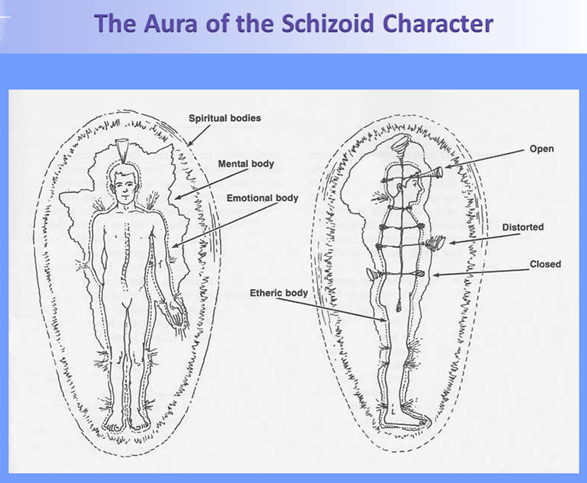
Esoteric Characterology describes most Schizoids as having a “Schizoid wound,” a physical injury that distorts the spine’s curvature and often leads to an energetic block. This condition is associated with the first chakra, where a weak aura in the feet indicates a sense of being ungrounded. The front of the second chakra is typically closed due to a lack of self-love. In contrast, the sixth and seventh chakras are open, allowing the schizoid to maintain a connection to the spirit world, live in their thoughts, and often dissociate. However, the back part of these chakras remains closed, as the schizoid usually has an underdeveloped will and struggles to manifest their ideas. This is why many schizoids find their niche in the construction-like environment of the meme factory.
.
Spiritual awakening is a cosmic and transient experience. When it passes, there is a desire to recapture that moment of enlightenment, to feel once again surrounded by light and grace, filled with bliss and insight. This often requires documenting everything before the momentum fades. In the pursuit of rediscovering this state, some individuals may become blocked or emotionally injured; adopting a schizoid mode where both body and spirit suffer. This can hinder their ability to attain spiritual awakening, whether it is the first time or a repeat. In this context, Plato’s Axiom becomes relevant:
When [the soul] tries to investigate anything with the help of the body, it is led astray.” When does “the soul get a clear view of fact”? [W]hen it ignores the body. – Plato
Although this adage was formulated during the last days of Socrates’ life, as Plato was one of his students and this dialogue is known as “Phaedo,” it reflects a profound misunderstanding of his death. The dialogue presents an argument centred on fear, whereby reason is detached from our other qualities. Plato aimed to convey to his readers the dualist view of the body and the soul, ultimately culminating in their separation at death. While Christians view this separation as an aberration or a spiritual disease, Plato regarded it as a natural function. In contrast to this thinking, when considering schizoids and spiritual enlightenment, the body needs to be in good health. Completeness means a flow of energy that is not obstructed by a weakened body, as Plato believed that the body represented the physical world we perceive through our senses. A compromised body can lead to the possibility of being misled when exploring ideas. At the same time, neglecting the body reflects the misunderstanding mentioned earlier. Aristotle entered the discussion with a more scientific approach, analysing the body from a biological perspective. However, his argument was less about empiricism than it was about recognising the importance of not dismissing other qualities.
If you find New Age beliefs lacking in substance, they can be seen as a superficial imitation or an insubstantial argument drawn from esoteric traditions, occultism, apocrypha, and psychological theories. One example is Moralistic Therapeutic Deism (MTD), which dilutes Christian morality into a concept focused on being “positive, happy, and good,” while neglecting crucial aspects of Christianity such as having a relationship with God, the ideas of sin, and salvation. While MTD emphasises personal fulfilment and self-expression, which may resonate with some activist movements, it lacks a direct comparison to “woke” ideologies, which primarily focus on social justice. MTD arises from a secularised interpretation of Christianity, whereas the “woke” concept is a secular ideology with its own origins and principles.
New Age’s weakness in reasoning stems from its inability to account for the existential evil present in the world. This issue may be closely tied to individual concerns about positioning oneself as a leader of cults formed around personality. I recall a documentary titled “Stoked,” which featured an ’80s skater named Gator, who claimed to have found Buddhism and cited New Age spirituality within his cult-like group—up until he murdered his girlfriend. The core question relates to authenticity. In the New Age world, authenticity is considered the highest vibrational frequency, creating a surreal situation in which utilitarianism pretends to be instrumental reason. This scenario reflects a combination of fallen angel pride—where pride is a form of fear—coupled with the stark terror that often accompanies leadership demands. For example, Trump embodies the posture of a leader-hero, yet his incompetence reveals the reality behind the facade. Similarly, Gator pretends to be “awake,” but he is merely posturing for fame as the archetypal skater hero, all while exhibiting absolute psychopathic tendencies.
In discussing psychopaths, the term “ace in the hole” is often associated with the Joker, a character synchronistically supercharged with meaning. The film “Joker,” starring Joaquin Phoenix, has been interpreted as a reflection of right-wing rebellion, further emboldening the darker corners of online society, particularly during Donald Trump’s administration. The phrase “ace in the hole” originated in poker, and the song “Poker Face” by Lady Gaga is noteworthy, especially considering she is set to play Harley Quinn in the sequel to “Joker.” Heath Ledger, who famously portrayed the Joker, died in a mysterious manner that has been linked to various conspiracy theories, including those involving the Olsen twins—one of whom is Elizabeth Olsen, known for her role as Scarlet Witch in the Marvel Cinematic Universe. The Joker is a trickster with an antisocial and anti-establishment nature, symbolising the tearing down of outdated systems to pave the way for new ones. This characterisation seems particularly relevant in our current times, often described as the end of an imperial era. Unlike the archetypal trickster, however, the Joker seeks only chaos and destruction without any redemptive qualities.
In the novel *Wild Cards: Ace in the Hole*, a parallel is drawn to the character of the clown in office, reminiscent of Trump. In this new alignment of stars, he represents the Beast from the Sea. An animated Batman series titled “The Joker Trumps an Ace” aptly captures the essence of *Wild Cards*’ plot. The story centres on Gregg Hartmann, who runs for president while secretly being the villain known as the “Puppet-man.” This villain is an Ace with psychic abilities, capable of controlling people’s emotions. The narrative follows his political campaign, alongside various characters determined to stop him.
Spiritual awakening is a state that many atheists may find challenging to experience due to their rigid mindset. However, a spiritual awakening occurs in them. In that case, it often leads to a collective desire to share their newfound understanding with others, much as in the heroic transformations depicted in films. In this scenario, the protagonist usually aligns with the overly precise “scientists say” approach, as if any profound change must first be validated by scientific authority. This situation can be likened to survivors of Evangelical cults, where only a small number feel the need to describe their experiences to others. At the same time, the majority who remain are still loyal and bound to the cult. The key difference is that those who have experienced spiritual enlightenment may not have a heroic goal or a strong desire to disclose their experiences; as such enlightenment is often beyond the limits of language.
Allan Watts once described spiritual awakening as a lived reality: “It’s the difference between reading about swimming and actually being in the water.” When you try to explain water to someone who has never been wet, what do they hear?, just words, sounds. The actual sensation of water—the way it holds you and moves around your body—cannot be fully captured in language. Those who are unawakened cannot understand because they have not had the experience themselves. You cannot give them a direct experience of awakening, and spiritual awakening is much subtler. Having been awakened, you come to realise that there is an inherent division when you try to explain the phenomenon. By categorising the awakened and the unawakened, you contradict the very insight you aim to share. There is no division, no separation, and no “you” and “them.” The awakened person learns to remain quiet about their experience of cosmic consciousness.

