Month: December 2025
Some link somewhere
Occultism and the Living World (18)

Mystics & Artist-Prophets:

.
Concluding our Evacuation Discourse: Awaken the Non-Voters: The discussion revolves around the fundamental question of evacuation—specifically, the idea of “evacuating the middle” across contexts such as politics, corporations, ideologies, religion, and the balance between scepticism and truth. This middle ground has become problematic, yet it is also fleeting. Its form can change, which means we can reshape it while preserving elements that are good, ethical, and moral. The core questions are:
- How do you evacuate the middle and assemble the form that remains while preserving the polarised citizens’ belief in democracy?
- How do you promote healthy scepticism within conspiracy theory without the right-wing pipeline engulfing it into their firebrand, and the left-wing simulating it into their hyperrealism and (false) facts branding?
- How do you then update a traditional (pre-Bruno) worldview while integrating the forms that seem probable from our modern/ contemporary one while dispensing scientism (hyperrealism) altogether?
- How do you evacuate fundamentalism from Christendom as these Christian adjacent cult groups of power grow and metastasise into something else as it engulfs into (nationalism) politics and conspiracy theory.
- How do you evacuate New Age thought from normal behaviour because like fundamentalism it has its own cult groups driven by spiritual grifting selling a great awakening or deliverance from an apocalyptic world to higher consciousness; ready for the invite for a larger galactic federation.
All these questions share a familiar theme of evacuation and reassembly of form. I may not be fully qualified to answer them, but I do have some ideas. Regarding the first question about democracy, I propose that the United States initiate a law requiring every citizen to vote. This law should include efforts to educate non-voters about both current and past fascist regimes and emphasise the importance of upholding democracy alongside the constitution as a vital blueprint. If non-voters participate in elections alongside those who typically vote, we could create a majority that would make it difficult for fascist nationalist movements to regain power. This participation would also help expose any corruption and guilt among democratic leaders. This approach has hope as opposed to completely splitting the country in two. There is hope for evacuation, as demonstrated by New York City, where democratic socialism has gained significant traction. The mayor is actively working to educate the population about these issues.
In this era of awakening, the challenges seem less daunting than they did during the Obama administration, when the backlash against Obamacare became intertwined with broader cultural conflicts. Society appeared more stable back then than it does now. Modern-day Democrats have lost their fortitude, having been weakened in the post-neo-liberal Clinton era. They are often forced to align with APEC and comply with Republican overreach. This is exemplified by Chuck Schumer’s betrayal of his constituents, as he has capitulated to corporate oligarchs and their agenda. Schumer has not compromised just once, but twice, during a government shutdown, failing to uphold his position on healthcare.
Neoliberalism, which originated during the Reagan era, has remained influential and is shaped by historical colonial powers. This ideology is based on the belief that civilisation advances only when a select few enlighten what are often referred to as “animist” tribes—reflecting an authoritarian mindset. Historically, symbols of war have been associated with civilisation, influenced by iconic heroic figures. However, conservatives often view war as a fundamental truth, believing that all life forms are destined to compete for limited natural resources while promoting their own ideologies. For Christian fundamentalists and conservatives, violence is seen as an inherent aspect of life. They regard it as inevitable and take pride in preparing themselves for it.
This same concept (of how we shape progress) is still in place today, the same moral sleight of hand that justifies capitalism—the CEO’s burden to uplift the working man by exploiting them while bringing us up with him. Trickle-down philosophy is a repackaged white man’s burden for modern capitalists. Capitalism itself is an inheritor of much of colonialism’s logic of time and progress as justification for exploitation and conflict. And violence is seen as this natural evolutionary process for progress; it’s a politically neutral worldview.
The idea combines American exceptionalism with evolutionary progress, suggesting that our natural progression towards a predetermined destiny is rooted in technology. During the Reagan era, archetypal heroes—often depicted as CEOs, financiers, managers, and brokers—were ambitious men whose personal successes were believed to benefit the working class through the trickle-down effect of their wealth. Reagan’s vision was infused with a sense of American nationalism and exceptionalism, in contrast to Thatcher’s belief in neoliberalism as a natural order of civilisation. Over time, this concept evolved into a focus on technocracy and a techno-fascist perspective, with figures like Elon Musk and Sam Altman leading the charge.
The so-called “techno-Alphas” who are leading the charge are merely portraying a fictional version of an Alpha type, the swagger in space persona. A persona that does not exist in real life; instead, they cling to a made-up character that allows them to express their megalomania and hidden desires through a distorted image. These individuals struggle to form genuine love or emotional connections, as this would require true empathic intimacy. Their inherent narcissism drives them to seek dominance over those they perceive as beneath them. Even when their behaviour is framed in terms of conquest, victory, ego, or control, it remains insincere and serves only as a facade for public relations.
Concluding our Evacuation: Seriality an Answer to Conspiracy Theory Uncertainty: The word “Kirk” has both symbolic and etymological connections to the concept of the traditional Church, which is referred to as “Kirk” in Scottish usage. In “Star Trek,” Captain Kirk commands the Star-ship Enterprise, which can be seen as a metaphor for the endeavour of building churches. This idea of enterprise may help explain why many churches are divided into different denominations. Additionally, the term “Kirk” is related to the Roman word “Ceres,” the name of a Roman goddess known as Mother Ceres. This name can be traced back to an even older goddess from Greek mythology named “Circe.” Circe is often depicted as a goddess of magic and, at times, as a nymph, witch, enchantress, or sorceress. According to most accounts, she was the daughter of the sun god Helios and Perse, an Oceanid nymph.
The podcaster Charlie Kirk is, therefore, the captain of his own Star-ship; he sits in a chair under his Church and wants to convince people to join his enterprise. However, I struggled to understand the admiration for Charlie Kirk, a podcaster known for his racist, sexist, and pro-Nazi views. While his death should not be celebrated, he also shouldn’t be viewed as a martyr or a saint. He has become an exaggerated symbol for racist nationalists within the MAGA movement, showing all the signs of being an astroturfed icon. His status implies a seriousness that doesn’t merit attention, and his bleak outlook resonates like nihilistic rays in his key efforts. He exploited the insecurities of young college students to convert them into Republican votes, taking advantage of their youth and inexperience to manipulate them in debate scenarios.
After his death, conspiracy theories swept the internet, suggesting it was a false flag cleverly designed to resemble an assassination. This alleged false flag reportedly used holographic cameras, mirrors, and shadows to create a deceptive illusion. The technology, primarily used by film and TV studios, can render realistic depictions of various scenarios. This represents a modern take on a mid-nineteenth-century illusion known as “Pepper’s Ghost.”

.
In Star Trek, they often have a specific room called the Holodeck. It uses holograms, force fields, and other technology to create a realistic, interactive 3D simulation of a setting, environment, or story.
The issue with conspiracy theories is their inability to establish fixed positions within a broader context, as their propositions have no limits. They tend to gravitate toward right-wing ideologies due to a combination of populist psychological predispositions, political context, and media dynamics. Ironically, the process used to analyse conspiracy theories can be confusing, as those engaging in this analysis often exhibit lower analytical thinking skills. These individuals typically align themselves with right-wing authoritarianism and social hierarchies. In the 1980s, this alignment manifested as a heightened perception of threat, encapsulated in the “five minutes to total doomsday” mentality. The media landscape has been heavily saturated by right-wing outlets, from Fox News to various podcasters, which has resulted in these perspectives overshadowing more progressive viewpoints. Political leaders have also drawn on conspiracy theories to bolster their ambitions and profiles, thus providing populists with a false figurehead to depend on.
They distrust mainstream government media and prefer to follow information silos and echo chambers, and as a result, promote their own motivated reasoning through ideologically aligned conspiracies. Alongside low institutional trust in government and the media, it’s a type of scepticism filled with cognitive dissonance. Similarly, left-wing scepticism is about following legacy news, and their left-wing firebrand is self-referentialism, “scientists say” dogma. They ignore scepticism from conspiracy theorists that might have some rational validity. Therefore, where does that leave the truth?
Sartre’s concept of “seriality,” as discussed in his critique of dialectical reason highlights a fundamental issue with conspiracy theories. In this context, serial social ethics can serve as a temporary placeholder for truth, with individuals collectively adhering to norms to ensure the best possible outcomes. Any resistance to this ethic is unproductive because it prioritises the establishment of laws that everyone must follow over individual rebellion or personal connections. The effectiveness of this experiment relies on a specific group’s willingness to conform to social logic, often motivated by a fear of being left behind. As a mere placeholder, seriality is interchangeable. To truly embrace a cohesive, liberated social existence, individuals must break free from this ordered structure. By doing so, we can exert our will to reshape our social and political realities. This process resembles establishing criteria for truth through laws that are subject to change, which may eventually prove certain truths wrong. For now, however, these laws define our understanding of truth.
Concluding our Evacuation Discourse – MAGA-Republicanism and the Crying Game: The personas that technocrats like Musk, Thiel, and Andreessen project allow them to express their hidden desires through a caricatured façade, particularly exemplified by the archetype of the “swaggering man in space.” This phenomenon closely resembles the fictional character Captain Kirk from Star Trek. I previously wrote about Elon Musk’s relationship with power, comparing him to Sartre’s exploration of Jean Genet’s homosexuality. After making a Nazi salute in front of the world, Musk became a representation of an inversion of Genet; he seems to have been liberated from morality by power. His Nazi gesture appears to serve as a symbolic tool, designed to ritualise his power and maintain his sense of untouchability.
Genet is portrayed as a monster after being caught stealing a cookie as a child, and the guilt thrust upon him through people’s gazes and assumptions penetrated him, transforming him into an object. The hand in the cookie jar is the crisis; the condemnation and guilt afterwards was the rape. Sartre says: “In our moral consciousness, a true rape can become unjust, yet inescapable condemnation; and, conversely, a condemnation can be experienced as rape. Both transform the guilty person, and he feels this objectification in his heart as a feeling of shame and in his sexual being as a subjection to coitus. From now on, Genet is deflowered; an iron grasp has made a woman of him; all that remains is for him to get used to being” [– Sartre]. After which, he would become a vestal of homosexuality.
Sartre’s examination Genet’s explores homosexuality, crime, and abjection not as simple identity but as a subversive performance, often focusing on the “macho” man and a system where the debased homosexual partner worships the heterosexual “pal,” exposing the theatricality of societal norms, and using the language of the oppressor (hetero-normative discourse) to critique it by revealing the constructed nature of “natural” masculinity and desire within a world that criminalizes difference.
Elon represents a perversion of virtue; he is a figure who, having gained power, has severed his ties to morality. His sense of guilt manifests through a troubling gesture that reflects his techno-fascist ambitions, which go largely uncondemned by both the elites and the general public. He is the one committing the violation, and it is impossible to instil morality in someone who exhibits narcissism and possesses an inflated, fragile ego. His actions have transformed those around him into monstrous versions of themselves, even causing his followers to adopt a certain “gayness.” This includes right-wing podcasters and mainstream media journalists who have publicly claimed that his gesture was merely an act of compassion, saying, “My heart goes out to you.” However, this “gayness” is not traditional; it’s more about guilt by association. Elon has turned them into his pawns, stripping them of their integrity and burdening them with his guilt and shame.
This situation with Trump’s ICE agents, manipulated by his Nazi senior advisor, whose fascist agents resemble the loser Proud Boys types and MAGA anti-woke individuals who arrest brown-skinned Mexicans, fuelled by Elon’s depredation of guilt. Arresting and importing with it that vestal of Guilt.
In an era where confident (Christian) Nationalist Republican leaders seem to protect abusers and gate-keep the release of Epstein files that could implicate the president, it is troubling to note that many of these leaders have been rumoured to be closeted homosexuals. The vice president, in particular, has often been criticised as a failed drag queen. They claim to hold the moral high ground, yet their actions reveal deep hypocrisy. Recently, Fox News commentator Jesse Watters (whose sexuality warrants further investigation) suggested to JD Vance that transgender individuals constitute an organised terrorist group. Vance responded by stating that any encouragement to commit acts of violence against the U.S. government or fellow Americans is characteristic of a terrorist movement. This statement feels out-dated, especially considering the ongoing discussions around the events of January 6, 2021, when Trump encouraged his supporters to storm the Capitol. This act, regardless of the extent to which it was planned, qualifies as a terrorist act. The comparison to transgender individuals as terrorists appears to be a straw man fallacy that distracts from the real issues at hand.
Transgender individuals want to live in a society free from discrimination. However, it often feels authoritarian and seeks to exploit them for propaganda purposes, similar to the oppressive tactics seen in Nazi regimes. Interestingly, data shows that some Republicans have an obsession with transgender erotica, with Oklahoma and Texas leading in searches on search engines. This contradiction highlights how their support for a regime that seeks to prosecute transgender individuals is at odds with their private interests. Moreover, there is a tendency to demonise women regarding their reproductive rights, especially in debates about abortion. The far-right and tech-fascists share a disdain for women, rooted in a cultural and religious perspective that views sexuality as shameful. The feeling of same sex lust, passion or desire is so abominable that they hate the object of their desire, leading to self-hatred and alienation. Such feelings can manifest as hostility towards the world, sometimes described as demonic in a spiritual sense. It’s essential to recognise that transgender people are victims of right-wing extremism, not the perpetrators of violence.
I recall Alan Watts describing the role of an actor as a means to momentarily convince us that they are not merely playing a role but truly living it. This illusion makes us believe, if only for a moment, that the fictional drama is real. Watts viewed this as a form of cosmic play, in which everyone plays a role (a persona) while forgetting that they are part of a larger drama—essentially, part of Brahman expressing itself. When we contrast this view with conspiracy theory phrases like “crisis actors,” “deep state,” and “false flags,” as well as with real organisations funded by intelligence agencies that create false flag events, we must acknowledge the very real implications of these terms. Currently, crisis actors are depicted as gun-wielding terrorists. Still, in modern discourse, the label of “terrorist” has shifted to include individuals associated with the transgender community and the incel movement.
The question arises regarding the monstrous nature of conspiracy theories, particularly as they have become increasingly aligned with right-wing and fascistic ideologies. There was a time when conspiracy theories distanced themselves from the extremes of right-wing fundamentalism; however, it’s possible they were never entirely free from it. This is similar to the concept of the “ace in the hole,” which connects with New Age beliefs and spiritual enlightenment, as it serves as a foundation for discussions around cosmic consciousness. Given this situation, we can attempt to transform these ideas by separating them from extreme ideologies. As I’ve suggested in previous posts, we should focus on a more holistic and balanced understanding, integrating concepts such as synchronicity and mysticism. For conspiracy theories and synchro-mysticism to remain relevant and beneficial, they must distance themselves from extreme right-wing viewpoints and adopt more politically neutral perspectives Otherwise narratives whether in schizoids’ memes or something else misrepresents itself concerning subjects that have not properly utilised Art as a balance between the individual and groups. Synchro-mysticism must remain neutral; otherwise, it risks becoming a form of conservative-synchro-mysticism, leaning too far towards one side.
Connecting MTD (Mystical Therapeutic Deism) with woke-ism may be a stretch. However, the approach of new atheism often involves stacking (false) facts in a way similar to how woke-ism assembles (politically incorrect/correct) morals to reach a rational conclusion. There’s a suggestion that “woke” emerged from the mystery cult movement and has been modernised, suggesting possible ties to contemporary governmental State-Cults; this idea may hold some truth. Furthermore, at various times, the transgender community has emphasised that they do not identify with or represent the state-cult’s own woke and transgender representatives, who often portray them as straw-man terrorists or agents of media propaganda. We must recognise these two distinct modalities: one with an agenda and the other seeking to exist authentically in the world. It’s essential to have the intuitive capability to discern between actual acts of terrorism and those that are clearly false flags.

Kai Anderson is a manipulative, power-hungry cult leader who uses fear and chaos to gain control, embodying both radical political extremism and toxic masculinity. He represents right-wing nationalist extremism, and his blue hair serves as a symbol of a more “woke” ideology. Kai gathers followers reminiscent of Nazi-like groups to narrate the story of the Jonestown Massacre. This is juxtaposed with a false-flag shooting in Nashville, carried out by a transgender woman wearing a red hat, which symbolises hatred. This contrast between the red hat and Kai’s blue hair highlights symbolic contradictions. The name “Kai,” which means “sea” in Japanese, is significant because it draws inspiration from Trump’s 2016 election, which fuelled the character’s terrorist arc in the show’s narrative. It’s suggested that Trump has been synchronistically associated with various archetypes, such as Ahriman, a MAGA hero (an inverse of Perseus holding Algol’s head), and the Beast from the Sea, often represented as a seven-headed creature. Additionally, the Nashville shooting involved three children and three adults who were not killed, making a total of six fatalities. When combined, these numbers result in 33, which raise further questions about hidden meanings and connections.
The State Cult further demonises Transgender people after the Charlie Kirk assassination, where the straw-man motif was in play on the shooter or by his association with his transgender partner. The fabricated document, written by intelligence agencies as false evidence to support their text conversation with each other, is reminiscent of an amateur writer developing their first screenplay, which does not convince anyone.
There is an online community privy only to Gen Z members, and contradictions, ignorance, lack of knowledge, and a lack of awareness of others characterise this world. In parallel to online white neo-Nazis and white supremacists, there exists a significantly misogynistic element within this group. Many of these individuals identify as confessed incels, and among them are subcultures known as furries. These groups often intersect, challenging the assumption that they cannot be part of the MAGA movement. In fact, some young people in the MAGA movement can become radicalised, reflecting a complex interplay of closeted transgender identities that intersects with furries and incels. They see the MAGA being too liberal for them, so they gravitate further right.
Marginalised individuals often grow up in overtly religious MAGA households, where they are expected to conform to gun culture, fundamentalism, and racism. In such environments, there is little room for them to express their true selves, leaving them isolated and seeking a sense of belonging in the darker corners of the internet. This search for connection can lead to further radicalisation, as algorithms work to distort their perspectives. There is a profound fear of coming out to their parents, peers, and church members, which can be overwhelming. This fear sometimes tragically results in suicide. When we consider this alongside the way state-backed groups use these individuals as propaganda figureheads, and how right-wing populists demonise them, the feeling of isolation only deepens.
In the aftermath of Kirk’s assassination, the government took significant measures to silence free speech, particularly highlighted by the firing of Jimmy Kimmel. Kimmel made remarks about Kirk’s connection to the MAGA movement, prompting the Trump administration to pressure the FCC to intervene against ABC’s affiliate, Nexstar, leading to Kimmel’s dismissal from his show. Unfortunately, the First Amendment did little to prevent such actions. Sinclair Media, a conglomerate that operates multiple local media outlets and is owned by major networks such as ABC, FOX, NBC, and CBS, has shown a coordinated pro-Trump bias in its broadcasts. They have proposed honouring Charlie Kirk during Kimmel’s former time slot and demanded an apology from Kimmel for his comments about Kirk and Turning Point USA. This effort to mainstream a controversial figure appears absurd, especially considering that individuals who simply echoed Kirk’s own statements have faced arrests and cancellations. Meanwhile, MAGA supporters seem to be rewarded with donations for using racist slurs against others.
Protesters led by taking the networks off, resulting in Kimmel’s reinstatement. Ironically, as comedian Kimmel faced the threat of being fired, Elon Musk, the owner of X social media, made a comment at CPAC about legalising comedy, claiming that the left is making comedy illegal. This reflects the same victimhood narrative as those who censor free speech—ironically protesting against the very thing they are guilty of.
.
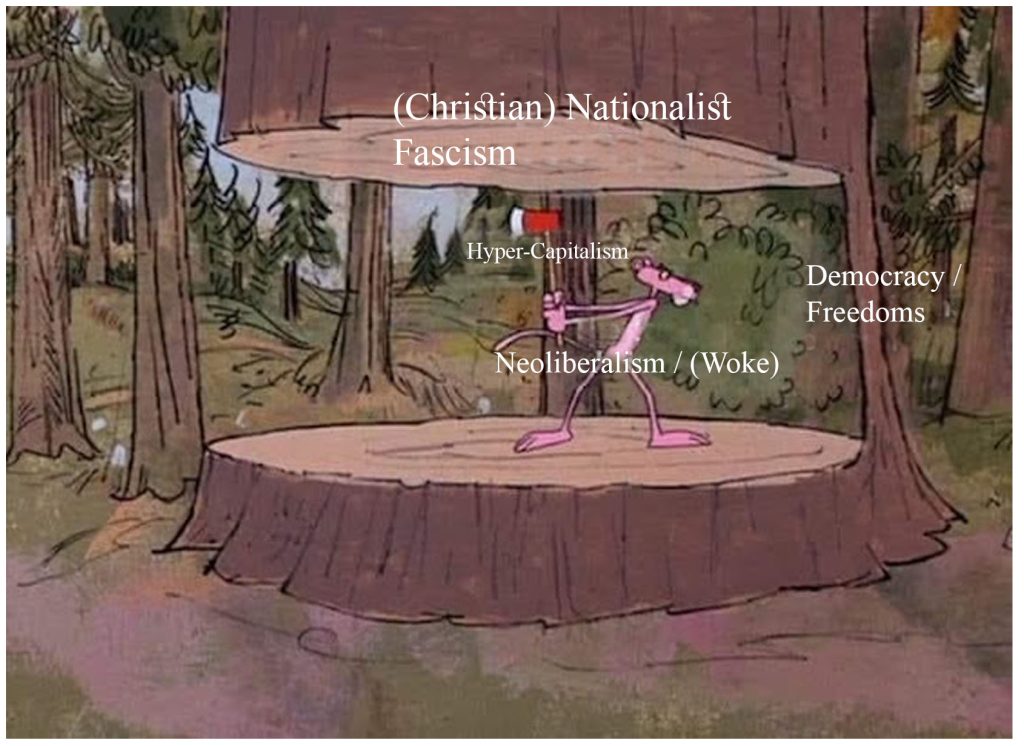
If this does not convince you that the numerous anti-woke memes flooding the internet are merely reactions to the failings of neoliberalism, then consider this: they serve as a parallel inverse atomiser that undermines the entertainment industry. The supposed apocalypse associated with it is a harmless projection, mirroring propagandised memes that aim real harm at the subliminal. Regardless, those who created the concept of “woke”—namely, billionaires—are the same controllers pushing for theocratic fascism. The key difference is that real threats are unfolding in real time, particularly during Trump’s administration. South Park’s Eric Cartman stated, “woke is dead,” essentially urging us to stop fixating on woke talking points that merely generate debates about gender-swapping roles in entertainment or diversity in acting. Instead, we should focus on defending our freedoms from actual authoritarian events.
Often fuelled by a group of billionaires who come together around a vision of a technological utopia –the narrative of our natural evolutionary journey toward destiny is deeply intertwined with technology, particularly as embodied by a prominent figure that many believe is to be Elon Musk. He is often seen as a visionary contemplating space colonisation and aspiring to create a utopia. However, this ambition raises questions about his perception of entitlement, as he seems to believe he has the right to do whatever it takes to realise his vision. These attitudes reflect a mindset characteristic of capitalism and colonialism, now prevalent among tech billionaires. This perspective draws from Darwinian ideology—particularly the phrase “survival of the fittest”—yet overlooks the crucial aspect of traits that best adapt to an environment over multiple generations. Moreover, cooperation may prove to be just as vital, if not more important, for survival than competition alone.
Elon Musk promotes social Darwinism and eugenics, driven by a misguided sense of fascistic heroic ethics, while being oblivious to the concept of an enlightened social Eden that his utopia should embody. He completely misunderstands and disowns his own transgender daughter, revealing that this supposed futurist embraces technological advancements without a corresponding commitment to good moral values. Issues such as structural racism, homophobia, political freedoms, and total economic security need to be addressed. Yet, those who position themselves as guardians of the Promised Land have yet to grow emotionally and spiritually.

.
He views his daughter as a victim of woke ideology, failing to recognise that his resentment is directed at a specific subset of woke transgenderism promoted by the State Cult’s own agenda concerning sex and gender. This ideology did not develop authentically and naturally over the past thirty years. Furthermore, he seems unaware that the State Cult’s motives reveal their hidden ambitions—though perhaps he does know, responding in a manner as sterile as the Hittite myth discussed by Pseudo-Plutarch. In this myth, a question arises: why does Mithras make a rock pregnant? The answer is that Mithras hates women. Initiates of these mysteries, much like those in Freemasonry, were exclusively male. The State Cult’s woke ideology surrounding transgenderism inevitably transforms into a reactionary stance, ultimately feeding into right-wing anti-woke nationalism and fundamentalism.
This argument revolves around the relationship between sexuality and spirit versus biology and fact. Biologically, it is a fact that human sexualities and sexual organs are typically associated with their respective sexes. However, variations can occur due to hormonal or chromosomal imbalances, and both hermaphrodites and intersex individuals exist, alongside that undergoing hormone therapy for gender identity. Critics (Trans-investigation) who create rigid templates based on assigned sex to evaluate transgender individuals are misinterpreting the complexities of human sexuality. To achieve accurate empirical data and statistics, one would need to conduct precise imaging scans of the bodies in question. Their flawed methodology leads to conclusions based on assumptions rather than facts. For instance, the misconception that women lack an Adam’s apple exemplifies the shortcomings of this approach. In reality, both men and women have an Adam’s apple; it is simply less prominent in women due to the more obtuse angle of the thyroid cartilage.
Trans-investigating reactionaries often exhibit paranoia similar to that of Christian fundamentalists. They believe that society is becoming more accepting of queer identities due to some unseen, insidious force. They become distressed when they realise that the women they admire and have framed on their walls might have been born male. While they claim to have nothing against transgender people, their anger stems from what they perceive as dishonesty and manipulation that threatens to confuse identity. These individuals see themselves as victims of a supposed agenda that inflicts guilt and promotes homosexuality. What they’re furious about is having the option taken away; to be found guilty or otherwise when they’ve already become the vestal of guilt/homosexuality. While most men are secure enough to shake off these concerns, some react with confusion, obsessively searching for signs of gender nonconformity. Ultimately, the issue is not solely about an unseen force or agenda—though that can be a factor—but about self-reflection and discovery in modern society, which has made being queer more acceptable.
Transgender individuals often identify as transgender (transgender woman or transgender man) rather than conforming to traditional gender constructs of woman and man. They acknowledge biological sex in its binary form. However, discussions about biology and sex, which tend to dismiss gender, have led to a scientific understanding that suggests gender exists on a spectrum rather than being strictly binary. This perspective is often linked to ideologies that create divisive spaces, as well as the bureaucratic machinery of state entities that aim to expand women’s rights while simultaneously challenging traditional masculinity. In the current political landscape, MAGA Republicans are not focused on expanding women’s rights; instead, they seem to be dismantling those freedoms through their political actions.
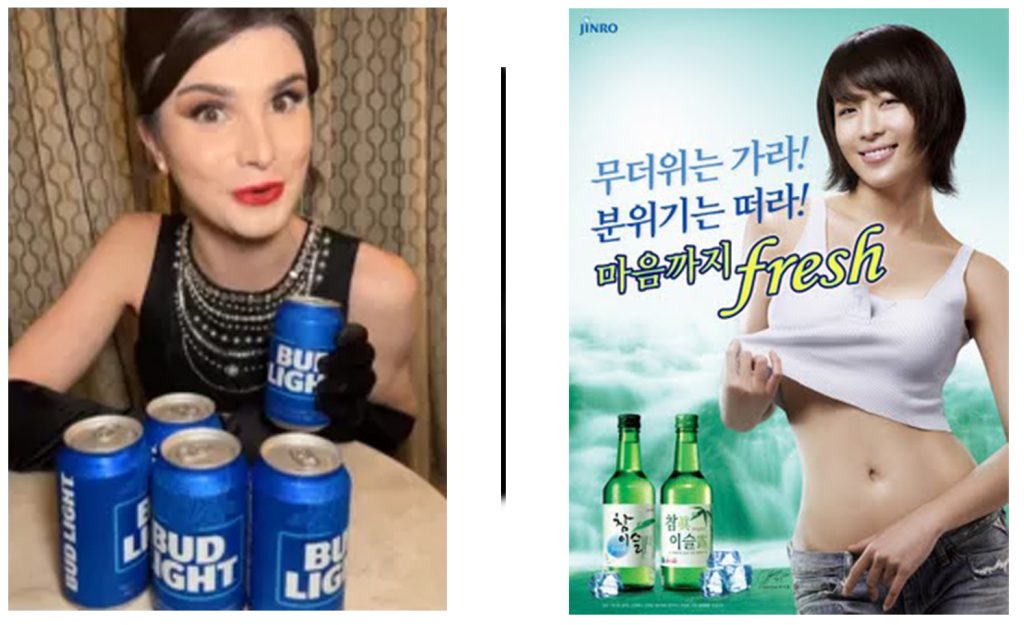
Here you can see the contrast between a country grappling with its insecurities and one that has none. The latter often chooses the least convincing transgender spokesperson as their representative.

The movement towards androgyny and transgenderism often emerges historically in the later stages of a culture, coinciding with societal decline. In the past, without access to hormone treatments, individuals who took on androgynous roles, such as sodomites, were typically initiates within their communities. In modern times, the increase in transgender representation can be linked to the rise of pornography and the evolution of the internet and technology. Late-stage civilisations, alongside these technological advancements, exhibit a unique sophistication. As a reactionary result, you get people in power convinced of the power of heroic masculinity (closeted or not) on the edges, starting to mask reality.
MAGA-Republicans and the Christian right’s focus on controlling women’s bodies reflects a more profound, subconscious desire to break free from their own spiritual limitations regarding sexuality. However, they have essentially imprisoned themselves due to religious and political beliefs, causing them to project their feelings of alienation and resentment onto those who are free from such constraints. This phenomenon can be seen in the ongoing efforts to restrict abortion rights, particularly as part of Project 2025. In several conservative states, laws are being proposed that would require young women who become pregnant as a result of rape to carry their pregnancies to term, even if it poses a risk to their health. These measures indicate a desire to control women’s bodies, often reducing them to mere vessels for childbirth. When policies are enacted to uphold a false moral stance, there is frequently a lack of support for that view, and social benefits that could help address the economic challenges of raising a child are often denied. This highlights the priority placed on ensuring that babies are born, regardless of the circumstances surrounding the pregnancy.
There is this tremendous disconnect between the transgender movement and woman’s rights alongside with what’s going on with right-wing government. In this context, morality becomes distorted, opening one door while closing many others. A clear example of this is when an adult imposes their moral beliefs onto a developing child’s body, which constitutes child abuse. A child is not emotionally or physically ready to make decisions about reassignment surgery. Therefore, there should be a law requiring individuals to reach a certain age; notably, eighteen before making such significant decisions. While the right-wing is against re-assignment surgery for children, it’s more about upholding nationalist talking point – as they fail in general to create social policies regarding children in the first place.
In ancient Gnostic creation myths, the Demiurge’s first breath of creation, known as Adamas, was androgynous, embodying both male and female aspects. This being was described as unified and complete, indicating that these early creation myths began with an androgynous existence. The subsequent division into male and female—represented by Adam and Eve as separate entities—was perceived as a “fall” into multiplicity and imperfection, resulting in entrapment in the material world. This separation is seen as the true fall. To attain gnosis (secret knowledge) and achieve salvation, one must reunify the separated masculine and feminine principles. Thus, the ultimate goal is this reunification.
In another Gnostic parable, the “Hymn of the Pearl,” the story depicts a reunion of spirit with spirit. It represents the human soul (the Prince) awakening to its divine origin (the King and Queen/Father and Mother). This awakening involves shedding its earthly and forgetful state, symbolised by the Egyptian clothes, in order to reclaim its true spiritual identity and return home. The parable serves as an allegory for Gnosis (knowledge) and spiritual rebirth, where the soul discovers its lost “pearl” (wisdom and self-knowledge) and reunites with its divine source. When considered alongside transgender identity, the story further illustrates the theme of the spirit’s body, shell, or clothing not aligning with its true essence. This misalignment is akin to wearing “unclean clothing” to fit in. Until the spirit reunites with the appropriate garment, it cannot fully express its true spiritual nature.
Concluding our Evacuation Discourse – Mithraism as the Unconscious Side of Christianity: There is an ongoing debate about whether all of Elon Musk’s children were conceived through traditional methods or via surrogacy. The Mithraic idea of creating a child from a rock has a modern parallel in the flat practice of artificial embryo creation. Musk and the so-called “Techno-fascists” align with Republicans in marginalising women and the transgender community. In the world of tech entrepreneurs, there is a notable desire to repopulate the planet in anticipation of an impending apocalypse, resembling a techno version of the Christian rapture. This is accompanied by a paranoia regarding declining birth rates and fears of demographic replacement, while also endorsing eugenics and a totalising brand of white nationalism. They tend to view individuals merely as utilities to be managed and exploited.
The State Cult’s religion is an ancient belief system characterised by a hyper-realistic understanding of space, where technology plays a crucial role in transcending this hyperrealism and driving profit. This religion is filled with contradictions, misleading its followers with a false sense of empiricism and relying on a distorted interpretation of science as its foundation. Ultimately, it seeks a deeper, secret objective: to escape the constraints of time by following a path rooted in ancient wisdom and symbolic understanding. This reflects the technocrats’ belief that space and technology parallel the pursuits of past secret cults, which sought immortality through ecstatic experiences. This delusional quest for technological advancement mirrors a desire to reach the stars via rockets. Ultimately, this is all a form of altar worship that leads to an opposite end: world accelerationism. As they safely reside in an underground civilisation, they prepare to emerge and seek out new lands, including those beyond Antarctica or the Ice Wall.
There is an ongoing debate about the historic connection between Iran’s version of Mithras and the one that emerged in the Mediterranean world; it seems this connection might be only in name. The earliest practitioners of Mithraism were members of a cult group from Cilicia that also worshipped Perseus. Mithras and Perseus share commonalities and may even be manifestations of the same cosmic deity. The mythic mystery represents the shadow side of the unchosen path, known only to secretive cult groups, while the rest of the world has pursued the more mainstream path of Christianity. This narrative is now being unravelled, revealing attempts to misdirect the general populace into believing something different.
.
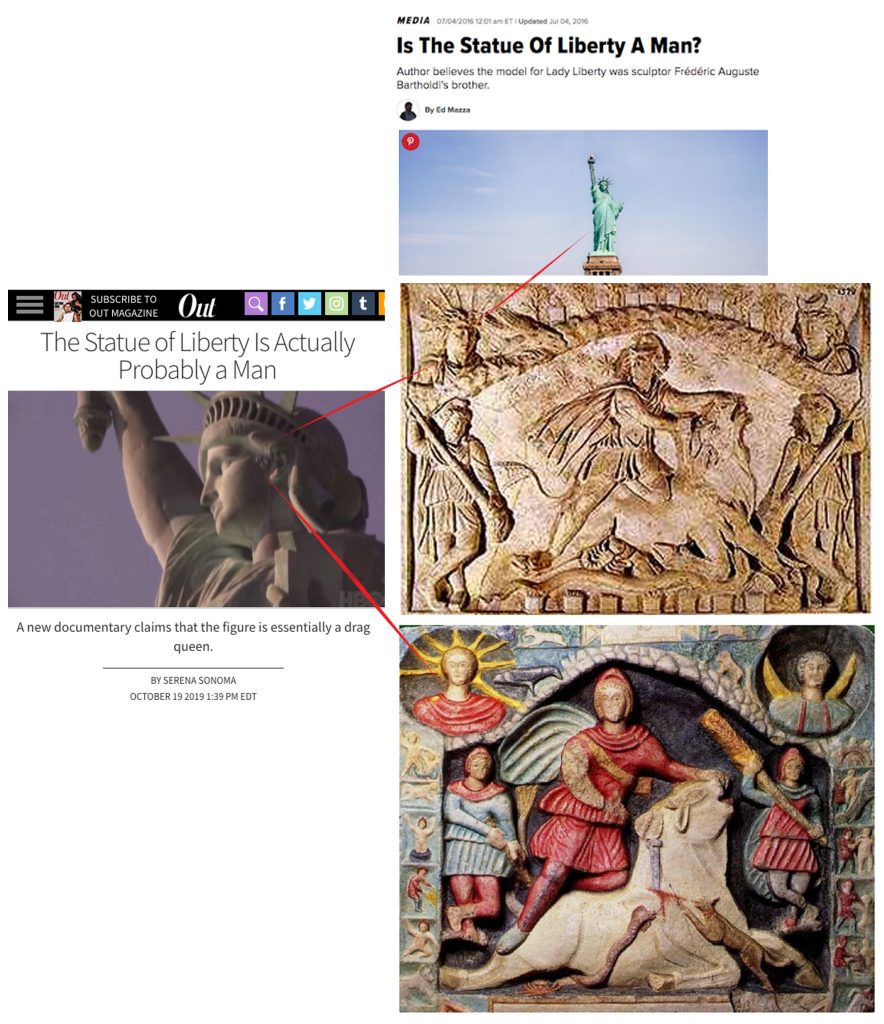
Mithraic symbolism embodies significant feminine principles of creation and the cosmos, linking Mithras to time (Chronos) and nature. This suggests a broader understanding of a non-binary divine nature. There are Grades in which the second grade is a specific character called Bridegroom or Nymphus, associated with Venus, and a humiliation ritual involving cross-dressing of the initiate. Mithras is not typically depicted as strictly androgynous; however, the cult embraced gender fluidity and duality, with male/female aspects (Mithras/Mithra), and influential cosmic figures like the Leontocephaline (lion-headed, serpent-wrapped). Mithraic symbolism encompassed powerful feminine principles of creation and the cosmos, linking Mithras to time (Chronos) and nature, suggesting a broader, non-binary divine nature.
Lady Liberty has a symbolic parallel to the Sun God of Mithraism (Helios), but not to Mithras, who is a cosmic being. The Sun God is male, while Lady Liberty is female. In a conspiracy-theory sense one could argue that there is a deliberate attempt to perplex the subconscious by State Cults who manage perceptions to confuse the spirit that follow ancient cults. Or is this a subconscious initiation for the people brought about deliberately or by accident, where the anima and animus converge in one artifice? The Moon Goddess of Mithraism is Luna/Selene, yet she receives little attention. Within the slaying bull depiction there are two torchbearers, they represent each end of the equinox their crossed legs symbolising that. Incidentally Lady Liberty holds a torch also, thus fulfilling three key Mithraism symbolic meanings. Is this part of a state cult’s intention to conceal an agenda, or is it merely coincidental, alongside logistical reframing to save time and labour costs?
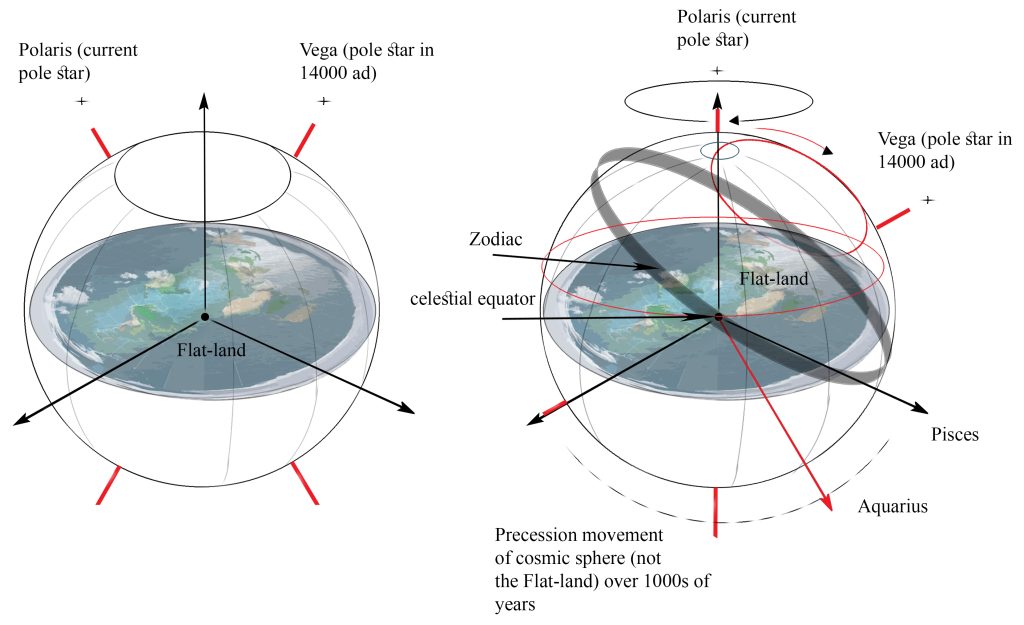
The infamous depiction of bull slaying appears to resemble a star map, with each icon representing symbolic meanings associated with the star constellations. Within the vast expanse of the stars lies the Zodiac, which spans a cosmic line across the sky. Additionally, there exists another cosmic line known as the celestial equator, which is essentially the Earth’s equator projected onto the celestial sphere. The Zodiac and the celestial equator intersect at two points in the sky, which correspond to the spring and autumn equinoxes. These equinoxes mark significant times for agriculture.
.
In antiquity, it was believed that the Earth was fixed and immovable at the centre of the universe, with everything else—such as the zodiac and celestial equator—revolving around it. What we now understand as the rotation of the Earth’s axis was once imagined as the entire cosmic sphere rotating around the Earth once a day. This sphere rotated around an axis known as the Great Cosmic Axis. There has never been anything fundamentally wrong with this view. In discussions about evacuation and form, we can update the pre-Bruno perspective by dismissing his transformed cosmic models and returning to their original concept. Currently, we are simply replacing the Earth’s rotation (which is considered inaccurate) with the idea of the cosmic sphere’s rotation—the movement of the stars. The precession movements we associate with a rotating Earth operate similarly to those of the celestial sphere. Furthermore, what appears to be a tilt in the Earth’s axis can be likened to the tilt of the cosmic sphere itself. Bruno, a solar cultist, placed himself at the centre of the universe and positioned himself above the celestial gods.
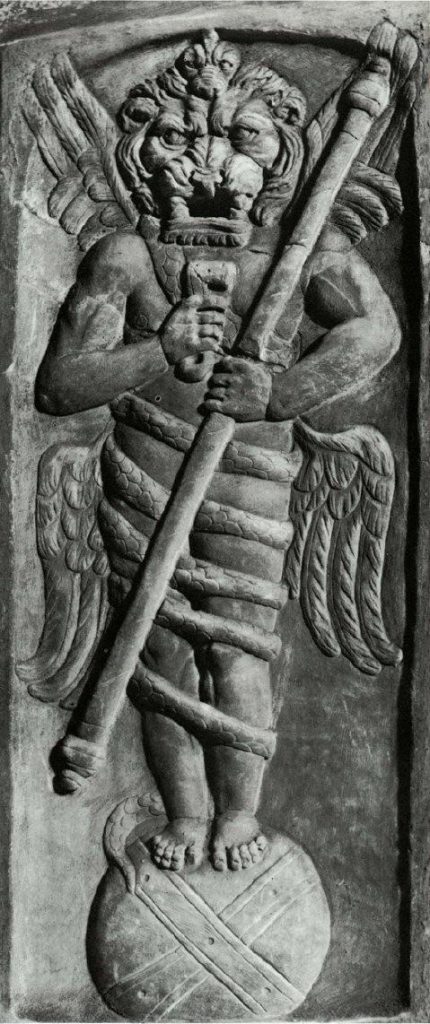
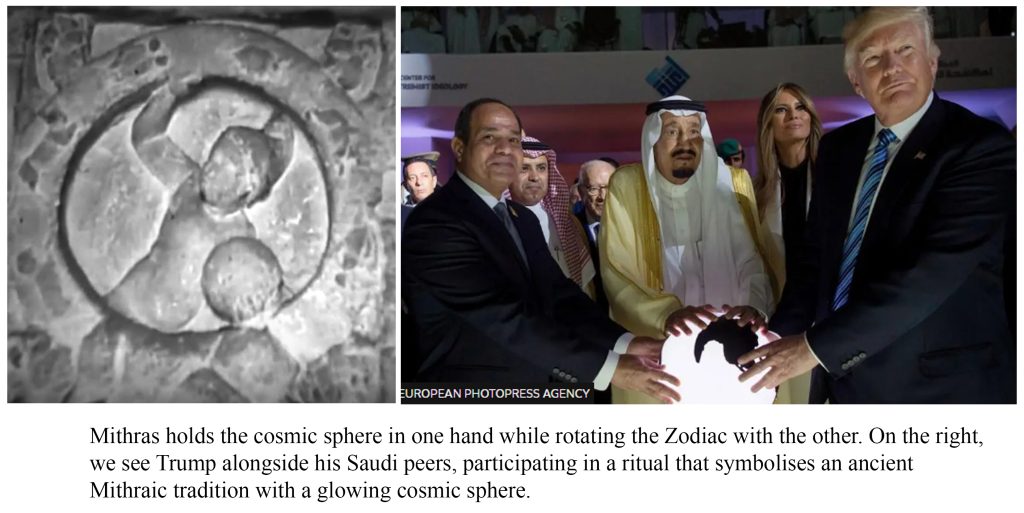
The line of intersection between the Zodiac and the Celestial equator creates a cross, and, from what Plato gathered about the Demiurge’s creation of this world, it begins at the intersection, symbolised by “x“. The Mithraic Lion-Headed God represents this intersection, and the image below shows the Lion-Headed God (a demiurge parallel) standing on a spherical cross. In his left hand, he holds a pole depicting the axis of the cosmic spheres.
.
In his right hand, he holds a key, symbolising the password that initiates must acquire to enable the soul, upon death or during ecstasy, to ascend through the planetary and dimensional spheres to the realm of the fixed stars. This journey of the soul after death to the heavens is perilous and challenging, with various obstacles to overcome and passwords to be learned at each stage of dimensional travel. Additionally, initiates employed magical breathing techniques, incantations, prayers, and sometimes mind-altering substances or ointments. They believed that a cosmic being capable of granting access to and moving between universes was worthy of worship, which gave rise to the practice of Mithraism. The symbolic death of the bull by Mithras represents a cosmic manifestation of the Lion-headed God’s power to navigate the universes, marking the transition from the constellation Taurus to Aries during the spring equinox.
In this mystical ascent, immortality is achieved by beholding the entire universe and upholding Mithras as a cosmic deity (not a solar deity). The ancient text also refers to a daughter who prepared the ritual ointment used by the initiates during their ecstatic or psychedelic ascent. Magical texts refer to daughters both literally and metaphorically, depicting them as apprentices. This could signify lower-grade (gender-bending) initiates. As is often the case, this makes me wonder whether Elon’s expostulation about his daughter is meant to distance him from a position that renders him ineligible for higher ambitions.
.
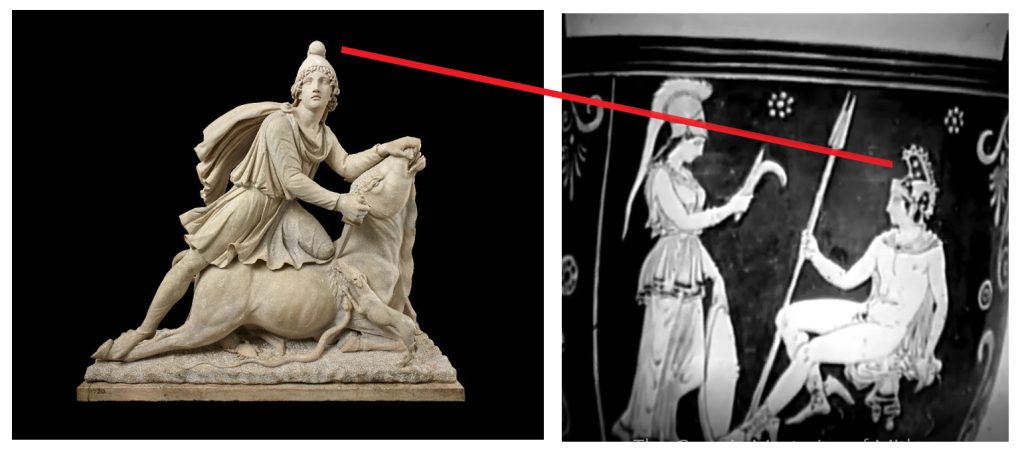
Mithra(s) is a cosmic manifestation of the lion-headed god. His emergence from a rock symbolises his miraculous, divine origin as a creator god who brings light and life to the cosmos. This sudden appearance signifies that he is a powerful deity who is both “born on earth” and greater than the cosmos itself, capable of transcending it. He accomplishes this by breaking through the cosmic sphere that surrounds the earth, an analogy reflected in the image of breaking out of the rock – He breaks from it yet has the power to control it.
.
As Mithras kills the Bull, he is positioned above the Bull in the constellation star map. Above Taurus is Perseus, who carries a dagger and wears a Phrygian cap, much like Mithras. Perseus serves as both a constellation and a hero. This journey of the soul after death into the heavens mirrors the modern State Cults’ mission to attain immortality through the allure of space travel and technology. However, it is essential to recognise that this quest is more spiritual than something that can be achieved through material means.
Concluding our Evacuation Discourse: The Techno-Manifest Destiny via New Age Accelerationism: In the last post, we discussed that self-awakening is a phenomenon that occurs in people, either directly or indirectly. Moreover, it offers valuable insight amid the new wave of age-old beliefs alongside modern spurious rationalists. Rather than merely providing an advantage, the experience emphasises achieving clarity amidst distractions. It serves as a reminder that awakening and enlightenment reflect a profound truth that remains very real, even in a sceptical and rational world. The phenomenon often parallels mystery traditions’ use of ecstatic travel via psychedelics alongside the miraculous experiences found in born-again Christians. However, differentiated by the qualitative needs of language that the new age provides as opposed to a more prophetic and mission interplay of Biblical Apocrypha or traditional mysteries.
.
Spiritual awakening is a transformative inner journey of realising one’s divine nature and unity with the universe, moving beyond ego to a higher consciousness, often through personal experience, meditation, and practices such as energy healing, leading to profound clarity, emotional shifts, and a deeper sense of purpose. However, it’s seen as a continuous unfolding rather than a final destination. Even awakened individuals remain human, experiencing emotions and challenges, but with a more accepting, less attached perspective, acting normal within society, yet knowing there is sacredness to it.
Experiencing the alignment of Chakra openings can lead to profound insights and understanding, often described as gnosis. Individuals may become hypersensitive and perceive orbs of light surrounding their bodies. The grace of god is frequently associated with a blissful sense of love, causing one to feel as if they are being lifted away. This experience can create a deep understanding of harmony and connection with the physical world, along with physical sensations that may include pre-cognitive dreams and psychic abilities. These transformative experiences can occur suddenly, leading to an overnight shift in perception. Instead of feeling like a passive observer, individuals may develop a strong desire to actively contribute to improving the world.
Spiritual awakening is a significant truth that reminds us that awakening and enlightenment are profound realities, even in a sceptical, rational world. In this context, there is a goal driven by the desire to improve the world, not through purely rational choices, but by tapping into deeper emotional connections. This awakening is fuelled by feelings of bliss and light, vis-à-vis our ace in the hole, in contrast to the motivations of techno-fascists, who often lack profound emotional spiritual experiences. This suggests that the elite may long to experience deeper emotions but are mostly limited to understanding rationality, dark magic (sorcery), ancient mythology, and the wealth generated by technocracy.
It’s clear that the tech-fascists have co-opted the language and core concepts of the new age, but they do so without fully understanding or experiencing true spiritual awareness. Instead, they adopt this language, along with its concepts and practices, to create a form of manifest destiny in space, using jargon associated with both technology and new-age beliefs. They fail to realise that genuine consciousness shifts are fundamentally opposed to this pursuit. The real advantage lies in the unique spiritual understanding that cannot be granted to those who are vulnerable to manipulation by their adversaries. Rather than engaging in a non-profitable exploration of ethics and morality, they would rather compromise their principles for technological advancement. As a result, we see a combination of reconstituted neoliberal ideas that prioritise profit over genuine spiritual growth.
Neoliberal democracies claim they are uplifting countries and bringing them into a better, more just society. This narrative is often framed against communism to justify its interference in other cultures, a justification that dates back to the Cold War and continued even after its end. The U.S. maintained this logic into the 2000s, particularly during the War on Terror, justifying the invasion of Afghanistan as a mission to stop terrorism, while also framing it as a moral duty to liberate women and girls from the supposedly backward and misogynistic Taliban.
This American intervention was deemed necessary to save Middle Eastern women through the lens of Western values. It follows a science-fiction archetypal motif of a post-sacristy utopia, despite its supposed evolution, running on the same logic: selling the dream of a better tomorrow while discreetly deciding who gets to build that future and who owns it. Similarly, modern tech billionaires continue this cycle of exploitation and justification. We see it real in time in Trumps’ administration that has started a war with Venezuela for its oil reserves. The costs to humans and the natural environment are often ignored. Yet, they are treated as necessary sacrifices to bring humanity towards its destiny—whether that means uploading consciousness to servers or travelling to the stars.
Marc Andreessen equates a Tech Manifest Destiny; not into a new west but into the stars, given space a false hyper-real assumption, and there is no more west to conquer – tech manifest destiny is all about effective accelerationism. A movement towards having a pro-technology stance, and assumes anything is justified in the pursuit of that creation. Their main crux argues that there is no restriction on their approach to technological progress. It pretends to have an ethical premise to overcome climate change, poverty, and conflict, but at its core are merely justifications for pursuing an expansive project with no limits on cost or regulation. In that pursuit, it ironically destroys its supposed ethical promise.
The pursuit of fictional science fiction concepts in artificial intelligence and transhumanism is a false promise. This is not merely a lack of imagination; rather, it reflects something predetermined (a false fact) already written in the fabric of time. Consequently, what remains is the commodification of these false promises, which are treated as prophecies for power and legacy. It is not just about gaining credit for technologies they believe will eventually exist; it is about playing the role of the Wizard behind the curtain, distracting the masses while advancing their collective agenda. They aim to emerge from their hidden underground bunkers and rebuild civilisation. This reconstruction, born of the collapse they have engineered through capitalism, will take the form of a utopian, neoliberal democracy.
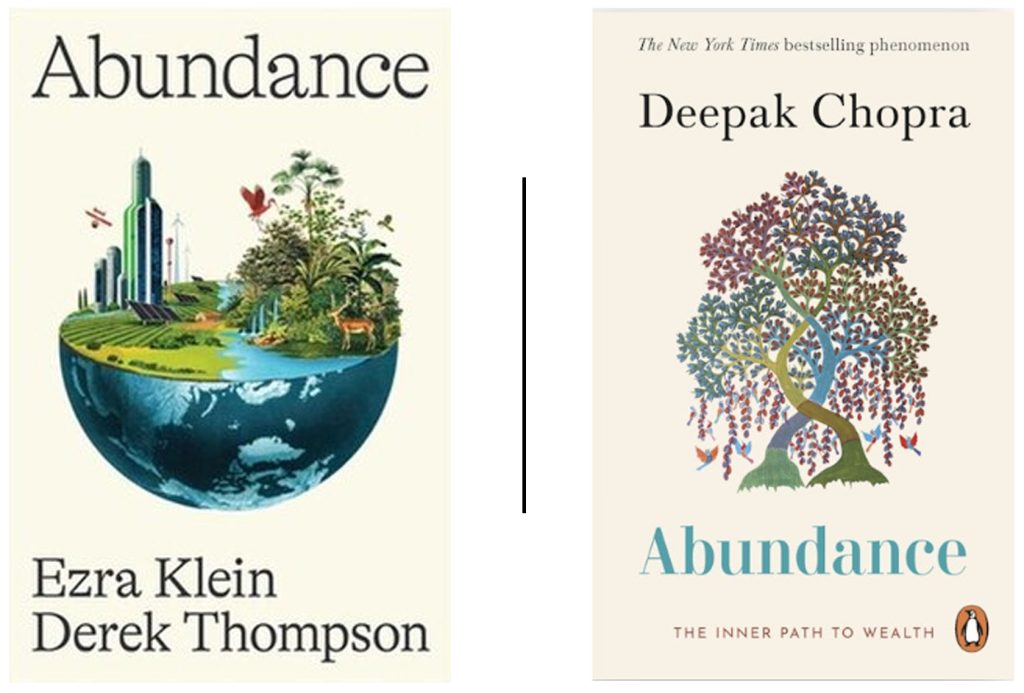
The Abundance movement derives its name from the New Age movement and emerged as a response to Trumpist fascism. However, it often blames progressive policies and social movements for being distractions or obstacles to economic growth. This movement advocates fewer regulatory frameworks, arguing that liberal cities, designed to promote equity and protect vulnerable populations, are part of the problem because they detract from genuine economic innovation. The Abundance movement seeks to eliminate these regulations and allow tech companies to operate without oversight. This ideology has the backing of Silicon Valley leaders, who are effectively handing control over to the oligarchs responsible for the current challenges we face. Ultimately, it reflects out-dated neoliberal ideas of trickle-down economics, rebranded for the Techno-bro era, and is packaged for Democrats who increasingly resemble a right-wing neoliberal party reminiscent of the past.
.
The Abundance Movement aims to create a world of plenty through policy, while its New Age counterpart focuses on experiencing abundance through belief. Both pursue the concept of “abundance,” but they take very different approaches. Trickle-down economics, promoted by proponents who resemble techno-Ponzi schemers, offers a misleading promise of abundance that will supposedly materialise once their technological dreams are fulfilled. This approach often repeats the same false promises of compliance, whether it’s about rebuilding solidarity with working people, uplifting immigrants, or protecting marginalised communities. Instead of genuinely addressing the capture of our institutions by fascist ideologies, it further empowers them—not through an overtly antagonistic political party, but through one that is deeply compromised.
Occultism and the Living World (17)

Mystics & Artist-Prophets:

.
Superpowers –You so Anti-Prophet, don’t Anti-Matter? (What?): As we continue to grasp the fundamental question of evacuation, or rather evacuating the middle (either in politics & corporations, ideologies & religion, and scepticism & truth), where the middle has become monstrous – yet it’s ephemeral. Meaning its form can change, and as such, we can reassemble that form while conserving what is good, ethical, and moral. How do you evacuate New Age thought from normal behaviour, because, like fundamentalism, it has its own cult groups driven by spiritual grifting, selling a Great Awakening or deliverance from an apocalyptic world to higher consciousness, ready for the invite to a larger galactic federation.
To understand the argumentative conflict between New Age religion and Christian fundamentalism, it is essential to recognise the fallacies inherent in both belief systems. By examining these fallacies, one can grasp the dialectical argument more effectively. Both perspectives strive to make us aware of the state of our world in an objective manner, encouraging self-reflection and knowledge that transcend the worship of the ego. Various factors, including culture, society, religion, media, nationalism, education, and government, profoundly condition us. Recognising these conditioning influences is crucial for countering deceptive narratives and manipulations. By doing so, we can create solutions for ourselves and acknowledge our mechanical behaviours, emotional addictions, and biases that lead us to reject information conflicting with our worldview.
The new age movement often embraces the slogan “spiritual but not religious,” a term coined by sceptics who may not fully understand its implications. This phrase evokes a powerful image of spirituality, implying a connection to the divine while rejecting the constraints of institutional dogma found in organised religions. However, this perspective falls short because it lacks a solid framework to advance beyond its initial claims. One major issue in the new age realm is that many of its teachings are diluted versions of ancient wisdom that have been around for thousands of years. Some concepts may even serve as deliberate distractions designed to lead people away from true understanding (similar to strategies used in programs like COINTELPRO). The new age groups often lack defences against misinformation, making them vulnerable to being influenced by new and potentially misleading teachings.
Concurrently, we already know in real time how diluted Christian ancient scriptures expressed by their pastors [dogmatically] or external Christian fundamentalist conspiracy theorists can lead people astray, where the same kind of rhetoric is used to gain favour for a populace cult base that support ultra-nationalism examined in Trump’s administration that are supported by oligarchs – who are dismantling its country’s democracy and freedoms, often recruiting false prophets like Charlie Kirk and many others adjacent to him to indoctrinate fascism and Nazism through rhetoric (podcasting) and debate. Religion has long been used to control society. Within these systems, common traits such as dogmatism, naive belief, wishful thinking, emotional projections, and a lack of critical thinking are characteristic of a controlling system.
The New Age has the same kind of control, but uses memory viewed through a complex form of romanticism. This perspective aims to shape the incomprehensible with personal experiences, creating a romantic vision that can often evolve into (cult) groups. These groups foster ideals of perfect love, race, and nation, which ultimately represent a distorted version of memory. And we know religious cult groups have the exact nature as most of their violence (shootings) stemming from extreme right-wing political groups and individual worldviews. Kirk happened to transition his cult-like rhetoric from an established nationalist base to mainstream eyes – to the detriment of the youth who his falsehoods may fool.
The concept of free will is not readily embraced when we are in a state of statism, governed by our conditioned personalities. It is a challenging task to help the demoralised recognise the true nature of our world—a self-inflicted prison. The reality is that freedom is merely an illusion, and many follow false heroes who serve as iconic figures but ultimately promote misguided truths that reinforce false absolutes.
The New Age movement adopts a system of control characterised by distorted teachings and a complacent mindset. Concepts such as “we are all one” (monism) and “all you need is love” are often oversimplified. This environment can give rise to pseudo-anti-gnostic cult groups that believe they are from another planet, creating a hyperrealistic depiction of longing for home. A notable example is Heaven’s Gate, a cult that believed that by taking their own lives during a series of UFO sightings, they would be lifted by spacecraft and taken to their true home. Many people think they are awake and aware when, in fact, they are merely dreaming of being awake or aware. This form of disinformation relies on half-truths mixed with falsehoods, keeping individuals trapped in a subjective tunnel vision.
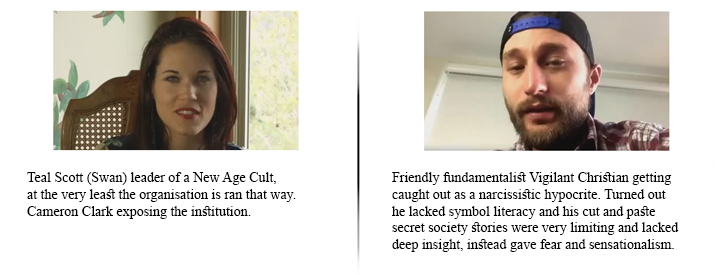
This approach has been used by various self-help gurus and others who claim to possess the secret to happiness and abundance. They promote techniques for manifesting money, finding fulfilling relationships, landing the perfect job, and attracting the ideal partner. Meanwhile, they make millions off the desperation of people who are genuinely seeking happiness and a way out of their struggles. The centre-right that promote Christian religiosity often use the same formula of self-help examined in the 12 rules for life with a psychological flavour. The New Age have been doing this for decades, and yet if fails because it has an inability to be objective in the real world, which in turn impart symptoms of personality disordered hysterical episodes in people. All because of the suppression of the true ego as opposed to the false ego set upon them by people and other outside sources.
Self-help teachings, such as “The Secret,” often appeal to the ego and its conditioned desires, promoting a relentless pursuit of those desires without truly understanding their origins. In contrast, spirituality and self-work should reflect the principles advocated by classic esoteric traditions. Unfortunately, modern spirituality often aligns itself with institutions that fail to perceive the world as it truly is. Archaic esotericism emphasises objectivity and, through understanding the “self,” allows us to navigate the world more effectively by dislodging unwarranted or unsubstantial information. The teaching of self-knowledge—encapsulated in the phrase “know thyself”—not only deepens our understanding of ourselves but also enhances our grasp of the reality in which we exist. If these elements are lacking from spiritual teachings, it is likely that they are incomplete, whether this is due to ignorance, conscious or otherwise.
Superpowers – Age of Awakening in an Age of Deception: Know thyself to discern reality from illusion and illusion from truth. Know that you are not waking to another form of illusion, don’t swap one master for another. Fundamentalist conspiracy theorists and MAGA podcasters promote this warning of swapping out masters, yet are unable to see their delusion regarding capitulating to fascism and demagogue adoration. While reinforcing a theocratic conspiracy, and adhering to its theocratic abstraction. Knowing a great deal about God, but knowing nothing of God. They love to think of their religiosity as gestating organically rather than originating in early Christian mysteries (or traditions).
It’s in this exclusivity that they can cherry-pick issues while believing they’re not part of an established corporation bigger than themselves. This delusion allows fundamentalists to exploit New Age conspiracy theory notions like the Aquarius Conspiracy while leaving out their own institutions’ nationalist interests. The Aquarius Conspiracy, which aims to create a unified New Age belief system, is a fabrication by fundamentalist conspiracy theory Christians. The perceived separation between them is merely an illusion of dialectic distinction, rather than an actual institutional separation. Two conspiracy roads always lead to the same conspiracy apparatus.
The denial and exclusivity of certain beliefs have evolved into a form of magical thinking. This occurs because individuals choose to believe in these ideas rather than understand them through empirical or experiential means. This mindset often originates from a motif of spiritual warfare, where fundamentalists are conditioned to adopt these beliefs from a young age. Throughout their lives, they become trapped in a cycle of worthlessness and rescue. Furthermore, they become primed to accept conspiracy theories, which resonate with them because of their dialectical nature. This is evident in the rhetoric adopted by Trump and his administration. It’s important to recognise that the established belief systems are politically neutral, rooted in ancient traditions, and steeped in archaic magic and symbolism. The rituals associated with these beliefs are deeply neo-pagan rather than Christian.
The elite’s belief in magic reflects the magical thinking of their cult-like followers. Even when it’s pointed out that the established belief system is based on fallen angel worship like Mithraism rather than traditional Christianity, they create ridiculous justifications to defend their saviour demagogue. This demagogue is primarily interested in himself and his oligarch allies, rather than in his followers, who are fed only scraps of nihilism and lies that leave them confused yet loyal. The followers sacrifice their critical thinking for the sake of belonging, even if that sense of belonging is within a death cult. They have rejected external reality in favour of internal mythology and demonise anyone who questions their vague sacred narrative.
They’ve labelled their demagogue as God’s chosen instrument—a MAGA perversion of Christianity that believes their demagogue is the paragon of Christ, and is their guiding force. Despite bestowing such a title on him, they fail to acknowledge his numerous sins, the laws he has broken, and the injustices he (and his administration) has inflicted upon the people, including his own followers. His followers exhibit a sadistic, self-centred, and unsympathetic worldview, where they prefer to see those they consider inferior suffer. They are willing to sacrifice their own interests if it means people they deem less than themselves also experience hardship. Some people prefer to view those they see as superior—those who possess empathy and the ability to rise above their own self-interest—because these qualities are often unrecognisable in themselves. As a result, witnessing the suffering of those perceived as superior in spirit can give them a sense of narcissistic satisfaction. Those perceived as inferior only desire the same universal healthcare and social security the rest of the Western world already enjoys, and they want to prevent what little they have in that regard from being further stripped away.
When you present MAGA cults with incontrovertible facts through evidence, such as recorded arguments from their leader presented in video and audio contradicting what he said months prior, when cornered, their mantra is “fake news,” deep state or Trump derangement syndrome. The abandonment of fact has become so complete that MAGA adherents inhabit an entirely parallel reality. Their universe deforms healthy scepticism to outright fantasy, “Idiocracy and their demagogue,” a film presented in Dolby, made in the pits of hell. Their loyalty test reinforces their cult-like status: you must agree with it all and have no reservations. You will become an outcast, thrown into the deep state repository of myth and fantasy. The cult’s binary conceives of loyalty as complete: you are either with the leader or the enemy.
There is no middle ground, no space for questioning the leader’s infallibility, even when he contradicts himself within the same sentence. The leader is a genius with intuitive capability; he’s not just a normal chess player, but a 4th-dimensional chess player capable of outmanoeuvring opponents in trade deals. Where the US’s economy points otherwise, the leader is a genius even when he suggests injecting bleach to cure Covid.
What this cult has done to genuine Christianity in the U.S. may be irreversible. Recognising the distinction between authentic faith and this distortion is the first step toward salvation. No group of Christian leaders can claim to speak the truth while endorsing the most prolific liar in U.S. history. The issue arises when Christianity is misrepresented as a MAGA religion. There is a stark difference between loving one’s neighbour and supporting policies that tear children from their parents’ arms at the border or outside a store.
The difference between the core belief of Christianity verse MAGA-cultism:
| Christianity & Liberals | Welcomed the poor and sick, and took care of them. |
| MAGA & Conservatives / Republicans | Will starve 100 people if they feel one person’s deserves it. Replaced love thy neighbour with we build the wall. |
| Christianity | Christianity discusses the power of Jesus Christ, and Christians demonstrated it: many people were healed and countless demons cast out on a regular basis. They were force to submit – in front of witnesses – to the name of Jesus. |
| MAGA | They have traded the Sermon on the Mount for a Red Hat. They have exchanged blessed are the peacemakers, they spit, we hit. Open to demonic thought forms, and therefore open to demonic possession. |
| Christianity | Christianity promised salvation from eternal punishment, through the death and resurrection of Jesus Christ, to everyone who believed: rich or poor, slave or free. |
| MAGA | MAGA Are pro-Zionists and pro-Trump; Republicans fund the Israeli military they actively bomb Palestine, resulting in the deaths of thousands of innocent people, including many children? This is for the promise of a New Jerusalem, where a City of Gold will descend. Institutionalized guilt & atonement in the name of Jesus Christ for absolving sin is promised by Christianity, but not of God. God is the ultimate Judgment. |
| Christianity & Liberals | Christianity offered the revolutionary doctrine of unconditional love – love the extended to all human beings, regardless of gender, age, social status, or race. |
| MAGA & Conservatives / Republicans | They are driven by the political arm of a cult of personality, immune to facts, reason or shame. Often confuse patriotism with nationalism thereby affirming a supremacy ideology (of whiteness), which is an ideology of hate. Has an over focus and misunderstanding of immigration where in part are immigrants themselves or at least ancestrally adjacent to it. |
| Christianity | Christianity promised eternal life on an everlasting paradise with God. It promised not only a new heaven, but a new earth, a type of eternal life that had never been available – and Christ was the only one who could provide it. |
| MAGA | Follow non-Biblical dispensational believe in a Millennial Kingdom where a New Jerusalem a City described in Revelation will descend from heaven to earth. They will become the eternal home for believers and Capital of God’s creation. There is also the Jew’s conversion or path to the second coming. |
.
Christianity does not have a monopoly on doing good or unconditional love. Just because a specific event, image or title is associated with good deeds does not make it exclusive to one belief system. Love is a universal principle, and claiming it is exclusive to Christianity is like asserting that only one source can provide oxygen.
One cannot truly understand love without also recognising fear; dualism is not a choice; it is part of our construct. Being aware of duality is an example of the ego being dissolved. Love and fear are vibrational frequencies that relate to our experience of reality. Love supports fear, and fear supports love. This connection arises from a foundational misconception: the belief that you hold as truth about God—that God cannot be trusted, that God’s love is not dependable, and that acceptance is conditional, leading to uncertainty about the outcome. If you cannot trust in God’s love to always be present, then whose love can you rely on? This is the delusion that creates the greatest enemy: fear. Doubt about the outcome of life translates into doubt about the creator and about God. If you doubt God, you may find yourself living in fear and guilt throughout your life.
Regarding scripture about casting out demons, it is crucial to understand that demons are spirits belonging to the realm of the spiritual world. In Christianity, there is a belief that only Jesus has the power to cast out these unclean spirits. Consequently, Christians believe that they can also cast out such spirits in His name. However, fundamentalists often claim that this ability is exclusive to Christians, meaning that practices of casting out spirits would not be effective for individuals from other religious backgrounds. The reality is that, whether you are Christian or not, such practices rarely work unless performed by a qualified priest, exorcist, guru, or magician. Even if they do work, the effects are often temporary, merely delaying possession rather than eliminating it. Additionally, it is worth noting that possession can sometimes mimic experiences related to astral dreaming.
From a rational standpoint, science attempts to explain these concepts through noetic science and similar fields. One must ask: how do unclean spirits or entities attach themselves to individuals and drain their energy? Often, it seems they do so by triggering trauma or inflicting emotional pain to feed off the energy of suffering, instead of accessing their own internal source—the kingdom of heaven within, which includes feelings of enlightenment and personal power. Instead of being drained through trauma or an inflated ego that spurs conflict, it is crucial to resolve these issues. Simply avoiding or attempting to rise above them is a fallacy. It is essential to confront and feel the energy associated with these triggers, to move that energy, and ultimately find freedom from it.
It is also important to understand the nature of Animism, the oldest belief system that predates organised religion. Animism shares common threads with spirituality and supernatural perspectives from around the world. It holds that everything in the world has a spirit or soul. This belief creates a multi-species spiritual community, often described as a swirling spiritual soup. While Animism acknowledges that spirits can be harmed when necessary, it primarily emphasises the need to respect the spirits of all things.
The central belief of Christianity, which Jesus Christ exemplified (salvation from eternal punishment), can seem impossible for humans to fully follow because it is based on ideals that can feel unattainable. However, the archetype of the myth from which this scenario is derived – along with the concept of the Christos (the inner Christ or Christ consciousness) – offers a more accessible way for individuals to connect with Christ. This connection can be pursued through understanding the Christos, engaging with its mythos, and cultivating faith.
Christianity began as a mystery cult that combined elements of Judaism and Paganism. Early Jews believed in a divine messiah—a celestial figure, sometimes referred to as Christ or Joshua—an archangel who was crucified in the lowest heavens. This concept is reminiscent of the ascent of Isaiah and is reflected in the writings of Philo of Alexandria, where he discusses the Logos. During the first three centuries, belief systems were quite diverse, and there was no single definition of what it meant to be a Christian or a follower of Jesus. Instead, there was a gradual process where certain interpretations gained dominance, leading to the definition of orthodoxy by specific individuals who subsequently excluded other followers of Jesus. This development culminated in the Church Fathers’ teachings, which established prevailing opinions while sidelining alternative beliefs.
It is misguided to assert that Pagan rhetoric overshadowed the rich spiritual and historical heritage that Christianity draws from Judaism and Paganism. Instead, Christianity itself emerged from this confluence of Jewish and Pagan traditions. Paganism exists as an archetype, suggesting that any notion of it corrupting the true monotheism of the living God and the Church originates from an encroaching new order rather than a deliberate plan. Finding a true Christian Religion completely independent of Catholicism is quite challenging—it’s so rare, only existing in the rigid minds of demoralised Christians. The Church and the occult often intertwine, which is why the idea of New Age Deception seems absurd when considering that the Church itself has Masonic connections. The core belief system of Christianity is still actively practised, prompting the question: where are the true Christians who stand apart from the Church? Their existence feels increasingly elusive—much like a unicorn, a topic theorised by religious scholars yet rarely witnessed in reality.
Superpowers – Inside a [Right-Wing] Demon Haunted World & the Counter Ace in the Hole: The New Age movement, while flexible and diverse, does not fully align with traditional religion or mainstream science. Instead, it embraces various mystery teachings. Mainstream science often labels the New Age’s connection to meta-science as pseudo-science, keeping it on the fringes of accepted knowledge. However, for those on a spiritual path, the reality of awakenings and enlightenment is profound, much like the concept of absolute consciousness. Personal experiences with cosmic consciousness can serve as strong confirmations of these beliefs.
There was a time when Nu-Atheists targeted New Age moderates in an effort to convert them to their brand of scepticism and rationalism. They often blend the rational aspects of actual science with the hyperrealism of scientism. This approach resembles any institutionalised psychological operation. Apparently, this atheist movement was funded by billionaires who aimed to emulate the qualities of Republicans and the Religious Right. However, the conversion did not gain much traction; it may have instead fostered a belief in the hyperrealism of space. New Agers tend to mythologise alternative planets, star systems, and galaxies, imagining a vast federation of worlds, a technologically utopian space, and a future in which our civilisation must aspire to be part of it.
The goal was to attract New Agers interested in Eastern teachings, such as Buddhism and agnosticism, and convert them to atheism. However, this effort was unsuccessful. Instead, what emerged was a mutually beneficial relationship in which self-referentialism and hyperrealist spatiality served as a rational framework for asserting absolutes based on purported facts. Although hyperrealism in space is presented as factual, it is inherently faith-driven. This ideology has roots in Rosicrucianism and the Illuminati, which were partly conservative movements. Modern cosmology has changed the perspective of many atheists, as it often rejects the zealotry of fundamentalism, pseudoscience, superstition, and New Age beliefs. This shift is primarily due to significant technological advancements.
The foundations upon which technology has developed are fundamentally flawed; they are based on a simulated version of reality (the hyperrealism of space is not genuine). However, the technology derived from this premise is very real. The key difference is that the language it produces has a rational structure. Still, it is as fanciful as the Montauk mythos, the new age channelers of descended beings, and various cringeworthy conspiracy theories about UFOs. Essentially, we should not conflate the principles of actual science with hyperrealism, nor should we treat hyperrealism as if it were as rational and empirical as science.
Science involves a healthy scepticism about the universe through accurate investigation, paired with recognition of its inherent complexities. However, this aspect rarely receives attention in the public relations sectors of the scientific community, where self-referential attitudes and PR agents may present assumptions as facts rather than relying on empirical evidence. It is a standard expectation to withhold belief without proof; for atheists, this reasoning is particularly emphasised. Yet, if the universe does not provide a solid foundation for its previous assertions, it can accommodate imaginative possibilities. Often, scientific theorising strays from its own logical foundations, leading to the emergence of false facts.
Atheists tend to confine religion to history, poetry, literature, ethics, and morality, arguing that it should not intersect with science. When such intersections occur, they view it as a violation of scientific integrity. While there is a clear distinction between myths and science, this perspective often stems from the belief that modern technology has outgrown earlier ideas. The development of scientific thought can be traced back to the Jews during their Babylonian captivity around 600 B.C. Throughout history, Roman Catholicism, reformed Judaism, and various Protestant denominations have collectively recognised that modern science has advanced significantly since that time. However, this acceptance of modernity often aligns with Bruno’s theory of satellite hyperrealism, which suggests that false notions in scientism, such as evolution, are treated as truths comparable to satellization and its view of the cosmos. Observations of evolution and similar transformations may sometimes resemble alchemical processes more than actual evolutionary changes, suggesting potential errors in the evolutionary framework itself.
Atheists also want to be their own stenographers, not bound by a collection of apocryphal texts whose faith is based in the Sky. They often mistake scripture for all-encompassing or view those who follow it as blinded by it, since it leaves no room for metaphorical interpretation. There should be a more esoteric relationship with scripture, where individuals see themselves as co-creators. Atheists have yet to acknowledge this aspect of co-creation because they tend to revert to self-referential thinking.
Carl Sagan’s book *The Demon-Haunted World* emphasises the importance of scientific thinking and scepticism in a world increasingly rife with pseudoscience and misinformation. Sagan argues that a population unable to distinguish between reliable information and falsehoods is vulnerable to demagogues and less able to make informed decisions about science and technology, which are crucial to the future of democracy. This warning was not remarkably prophetic; Sagan was recognising a pattern of fascism (that other intellects have come realise also) that has repeated itself, culminating in the Trump administration.
The belief held by some atheists that science and democracy are inherently linked is rooted in a misunderstanding and reflects a state of demoralisation. Teaching those who are demoralised can be challenging. The issue lies more with elites who worship ancient religions hidden within a secularised framework, often unaware of this influence. They define themselves through the phrase “scientists say,” where hyperrealism and empiricism intermingle. This situation is compounded by supportive racist governmental managers who operate outside the law and the constitution. Additionally, there is a base of populism characterised by religious nationalism and racism, exemplified by the MAGA movement, which ultimately influences political outcomes.
The text wants to categorise scepticism as pseudoscience by principle. This raises the question of whether science and its hyper-real counterpart, scientism, could also be considered pseudoscience, or at least the hyperrealism aspect is pseudoscience. Carl Sagan refers to this kind of flawed reasoning as “unreason,” which highlights the dangers of mass manipulation as a threat to civilisation, particularly within the MAGA populace. As for traditional Christians, I hope they bring more to the table than just a demoralised mindset, especially those on the esoteric edge (esoteric-Christianity). Those at that edge can recognise logical fallacies and maintain a healthy scepticism toward new claims.
As for Nu-atheism, it’s a dying institution and ideology, only surviving on life support through the efforts of leftists who try to counter an overly extreme fascist right-wing independent media. This is perhaps unavoidable, as the right-wing populace often distrusts data-driven facts. When they confront the truth of this data, they may feel silenced and choose instead to accept falsehoods and continue on their path. However, there is often a mix of facts, those influenced by scientism, and statistics driven by an agenda.
Carl Sagan’s perspective can be viewed as inherently atheistic, which aligns it with leftist political ideology by default. This viewpoint is reinforced by rational leftists who seek to validate their own self-referential beliefs. The premise of Sagan’s argument is to reject magical thinking; however, it fails to recognise that scientific hyperrealism itself can be considered a form of magical thinking. Ironically, the era of leftist non-believers coincided with a period rich in symbolic activity, particularly during the Obama years. This time served as a fertile ground for magic and ancient symbolic rituals that permeated the media landscape. Public figures like Neil deGrasse Tyson, Brian Cox, Richard Dawkins, and Bill Nye, often hailed as scientists, can be seen as akin to purveyors of deceptive magic, cloaked in hyperrealism (the “demon heads”). Additionally, this movement is supported by billionaire funding from individuals like Elon Musk, whose transhumanist and technocratic ambitions combine elements of fanciful scientific fantasy.
Elon Musk shifted to the far right when he endorsed Trump for president. The concept of “Demon Heads” becomes a subjective trope and politically neutral because these figures exist at opposite ends of the political spectrum. Atheists often embrace New Age concepts as long as they do not align with true Christian beliefs. This tendency is prevalent among many in Silicon Valley, who tend to be New Agers while promoting their ideas through a cult-like appeal. I have suggested that scientism can be seen as a subset of an alchemical movement, specifically a Rosicrucian Illuminati Protestant influence that gained traction after the death of Giordano Bruno. However, it is important to note that scientism itself is a modern concept. Its initial emergence among atheistic sceptics slowed down following the controversies surrounding Jeffrey Epstein. As Epstein was one of the financial backers fuelling the pseudo-scientific aspects of science, his downfall contributed to the decline of scientism.
It seems counterintuitive to reconcile rationalism and the empirical certainties of science with scientism, which resembles angel worship and Mithraism—a form of religion. It feels as though there is a strong hold over empiricism, while simultaneously endorsing a technocratic worldview. This perspective suggests that salvation can be found through technology rather than through the overcoming of evil. This mentality arises because those promoting it are, in a sense, the practitioners of that evil. Moreover, it is also counterintuitive to appease a fascist-populist (Christian) nationalist group that has emerged from neoconservatism, which promotes the Greater Israel project. This is reminiscent of the war efforts related to the concept of a war in heaven, coupled with sympathies for Zionism.
The term “Ace in the Hole” in this context refers to a valuable insight or discerning element that facilitates the interplay of intuition and facts. It allows one to set aside extreme realism or biased beliefs, preventing them from falling into speculative conspiracy theories and esoteric interpretations that amount to mere opinions. It represents a hidden advantage or secret resource that an individual can utilise at the right moment to gain an upper hand. In terms of spirituality, this “Ace in the Hole” encompasses significant spiritual developments, such as awakenings, enlightenment, or cosmic consciousness events that often occur unexpectedly. These spiritual evolutions usually come with specific abilities, frequently psychic in nature, akin to a superpower. This experience of awakening is not meant to be compared to the achievements of renowned enlightened figures like Buddha; instead, it shares similarities with their pathways to enlightenment. Instead of simply providing an advantage, the experience is about achieving clarity amidst distractions. It serves as a reminder that awakening and enlightenment represent a profound truth that is very real, even in a sceptical and rational world.
That noise comes from sceptics, doubters, and atheists who attempt to transcribe overly complex doctoral arguments focusing solely on absolute facts, without considering intuitive insights. They await profound revelations instead of actively seeking them. These individuals cling to a hyperrealism that was invented by esoteric mystics and secret religious cults, which later evolved into the cosmology of science. Unaware that these concepts are derivatives of ancient mysteries, they develop languages of mathematics, astronomy, and physics to support their scientific absolutism. Equally noisy are the New Agers, who indulge in a placebo-driven euphoria characterised by love and light. They remain untroubled by the intrinsic paradox of their beliefs, which deny the existence of a personal God while proposing that the universe itself embodies divinity. It’s essential to remember Pascal’s assertion that both faith and disbelief are equally possible within the limits of reason.
Only specific individuals immersed in New Age beliefs feel unfulfilled by it and choose to return to traditional Christianity—specifically a form of Christianity that is separate from the cult of fundamentalism, which imposes strict, linear reasoning. These individuals flee because New Age ideas have created a fantasy mythology rooted in UFO mysteries and ancient creation stories, often turned into fan fiction, all filtered through the inauthenticity of a hyperreal cosmos. For most people, the linear constraints of time are not a concern, as they understand that time, while often perceived linearly, does not function that way.
This is why many atheists tend to gravitate toward New Age beliefs rather than traditional religions, if they explore spirituality at all. They quantify intuitive acts and archetypes into mere downgraded deconstructs of “memes” – a trend supported by researchers who study memes, often inspired by Richard Dawkins, who coined the term “meme” and developed meme theory. However, this concept can be viewed as a lesser derivative of Jung’s archetypes. Memes, in essence, represent mere noise that neither conveys truth nor provides education; instead, they reflect fragmented opinions that lack depth and are often used for parody, instilled like a cartoonist panel, which can lead to disillusionment. Much of this culture can be traced back to the darker corners of the internet, including sites like 4chan and those with extremist views. While there will always be imitators and those who dilute the essence of these ideas, if you remain open-minded and aware, you can differentiate between those who have genuinely pursued spiritual enlightenment and those who are simply following trends without commitment.
After clearing away the noise, we are left with a rational exploration of consciousness that attempts to measure it scientifically through concepts like Chakras, sacred geometry, meditation, channelling, crystals, and ascension—each rooted in the ancient practice of alchemy, which seeks transformation and deeper understanding. The New Age movement is fluid in nature and exhibits characteristics of a symbiotic structure. It has even embraced aspects of hyperrealism, incorporating ideas from modern physics such as universal geometry, Platonic elements, black holes, and the vacuum of space, singularities, evolution, and toroidal and magnetic flows. The potential of the New Age lies in its ability to blend meta-science with spiritual elements, alongside imaginative concepts of UFO experiences and paranormal phenomena. It offers the appealing aspects of religion while introducing new, recycled myths without fully becoming a traditional religion. However, if it begins to adopt overly dogmatic religious sentiments, it risks losing its unique appeal.
The concept of the “Ace in the Hole,” or spiritual awareness, represents a distinct reality that stands out from those who may dismiss it entirely or interpret it through a heroic outsider lens of schizoid archetypes and memes. Some individuals argue that 99.9% of all religion, esotericism, occultism, and New Age spirituality are nonsensical, considering only 0.1% to be genuinely salvific. This reductionist approach offers a false sense of salvation from moral evil by presenting improbabilities as possibilities, while dismissing everything else as nonsensical. These individuals misunderstand spiritual awakeness—distinct from mere awareness—as it integrates the passive aspects of intuition and applied animism. This integration involves discovering how to dwell within a larger, synchronistic reality. Spiritual enlightenment is a higher form of intuitive action, surpassing the applied animism found in synchronistic mysticism. In turn, synchro-mysticism is just one subset of an intuitive gnostic approach, focused on meaningful coincidental patterns.
This statement suggests a rational approach to spirituality, particularly through the lens of synchronistic mysticism, which integrates rationality by recognising meaning in coincidental patterns engendered by mystery traditions and specific events in history. Its process instils an intuitive animist rational framework. However, synchro-mystics often overlook the higher forms of intuition, yet in their contradiction blend mysticism with their beliefs. As a result, it denies a broader perspective that reflects the interconnectedness of our lives with a vast continuum of time, people, and places. The seemingly nonsensical essentialities—regardless of personal feelings—provide context and can be seen as remnants or “fossils of consciousness.” Spiritual awakening and enlightenment represent the light of grace that inspires and fuels intuition, embodying the principles of synchronicity and synchro-mysticism.
This may not be the context that one might expect, but it is essential to consider how we can free ourselves from such contexts. Ultimately, true freedom arises from this process. It might seem uneasy to think that we can possess both a rational understanding and a spiritual dimension. Many find it challenging to differentiate the spiritual realm while still being a part of the physical world, where the unthinking forces of nature, like rocks and animals, exist. For those who view complexity and uncertainty merely as rational choices between freedom and subjugation, this duality appears fictitious.
Schizoids and memes represent an effort to counter the influence of a right-wing, Nazi-driven media pipeline that primarily spreads right-wing propaganda through memes. These schizoids create memes that have a similar appeal to those found in extremist circles but are less confrontational and not aligned with fascist ideologies, often distancing themselves from the more aggressive content produced by 4chan users and Nazi role-players. This approach allows other meme creators who do not support fascist ideas to participate without directly engaging with those themes. However, it’s important to recognise that, in general, memes can contribute to cognitive decline (brain-rot). Additionally, schizoids may not have a strong reputation among meme creators, as they tend to align more closely with introverted and stoic personalities.
Esoteric Characterology describes most Schizoids as having a “Schizoid wound,” a physical injury that distorts the spine’s curvature and often leads to an energetic block. This condition is associated with the first chakra, where a weak aura in the feet indicates a sense of being ungrounded. The front of the second chakra is typically closed due to a lack of self-love. In contrast, the sixth and seventh chakras are open, allowing the schizoid to maintain a connection to the spirit world, live in their thoughts, and often dissociate. However, the back part of these chakras remains closed, as the schizoid usually has an underdeveloped will and struggles to manifest their ideas. This is why many schizoids find their niche in the construction-like environment of the meme factory.
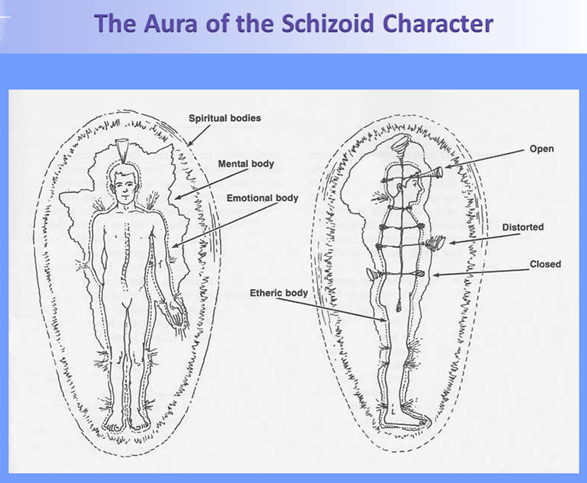
.
Spiritual awakening is a cosmic and transient experience. When it passes, there is a desire to recapture that moment of enlightenment, to feel once again surrounded by light and grace, filled with bliss and insight. This often requires documenting everything before the momentum fades. In the pursuit of rediscovering this state, some individuals may become blocked or emotionally injured; adopting a schizoid mode where both body and spirit suffer. This can hinder their ability to attain spiritual awakening, whether it is the first time or a repeat. In this context, Plato’s Axiom becomes relevant:
When [the soul] tries to investigate anything with the help of the body, it is led astray.” When does “the soul get a clear view of fact”? [W]hen it ignores the body. – Plato
Although this adage was formulated during the last days of Socrates’ life, as Plato was one of his students and this dialogue is known as “Phaedo,” it reflects a profound misunderstanding of his death. The dialogue presents an argument centred on fear, whereby reason is detached from our other qualities. Plato aimed to convey to his readers the dualist view of the body and the soul, ultimately culminating in their separation at death. While Christians view this separation as an aberration or a spiritual disease, Plato regarded it as a natural function. In contrast to this thinking, when considering schizoids and spiritual enlightenment, the body needs to be in good health. Completeness means a flow of energy that is not obstructed by a weakened body, as Plato believed that the body represented the physical world we perceive through our senses. A compromised body can lead to the possibility of being misled when exploring ideas. At the same time, neglecting the body reflects the misunderstanding mentioned earlier. Aristotle entered the discussion with a more scientific approach, analysing the body from a biological perspective. However, his argument was less about empiricism than it was about recognising the importance of not dismissing other qualities.
If you find New Age beliefs lacking in substance, they can be seen as a superficial imitation or an insubstantial argument drawn from esoteric traditions, occultism, apocrypha, and psychological theories. One example is Moralistic Therapeutic Deism (MTD), which dilutes Christian morality into a concept focused on being “positive, happy, and good,” while neglecting crucial aspects of Christianity such as having a relationship with God, the ideas of sin, and salvation. While MTD emphasises personal fulfilment and self-expression, which may resonate with some activist movements, it lacks a direct comparison to “woke” ideologies, which primarily focus on social justice. MTD arises from a secularised interpretation of Christianity, whereas the “woke” concept is a secular ideology with its own origins and principles.
New Age’s weakness in reasoning stems from its inability to account for the existential evil present in the world. This issue may be closely tied to individual concerns about positioning oneself as a leader of cults formed around personality. I recall a documentary titled “Stoked,” which featured an ’80s skater named Gator, who claimed to have found Buddhism and cited New Age spirituality within his cult-like group—up until he murdered his girlfriend. The core question relates to authenticity. In the New Age world, authenticity is considered the highest vibrational frequency, creating a surreal situation in which utilitarianism pretends to be instrumental reason. This scenario reflects a combination of fallen angel pride—where pride is a form of fear—coupled with the stark terror that often accompanies leadership demands. For example, Trump embodies the posture of a leader-hero, yet his incompetence reveals the reality behind the facade. Similarly, Gator pretends to be “awake,” but he is merely posturing for fame as the archetypal skater hero, all while exhibiting absolute psychopathic tendencies.
In discussing psychopaths, the term “ace in the hole” is often associated with the Joker, a character synchronistically supercharged with meaning. The film “Joker,” starring Joaquin Phoenix, has been interpreted as a reflection of right-wing rebellion, further emboldening the darker corners of online society, particularly during Donald Trump’s administration. The phrase “ace in the hole” originated in poker, and the song “Poker Face” by Lady Gaga is noteworthy, especially considering she is set to play Harley Quinn in the sequel to “Joker.” Heath Ledger, who famously portrayed the Joker, died in a mysterious manner that has been linked to various conspiracy theories, including those involving the Olsen twins—one of whom is Elizabeth Olsen, known for her role as Scarlet Witch in the Marvel Cinematic Universe. The Joker is a trickster with an antisocial and anti-establishment nature, symbolising the tearing down of outdated systems to pave the way for new ones. This characterisation seems particularly relevant in our current times, often described as the end of an imperial era. Unlike the archetypal trickster, however, the Joker seeks only chaos and destruction without any redemptive qualities.
In the novel *Wild Cards: Ace in the Hole*, a parallel is drawn to the character of the clown in office, reminiscent of Trump. In this new alignment of stars, he represents the Beast from the Sea. An animated Batman series titled “The Joker Trumps an Ace” aptly captures the essence of *Wild Cards*’ plot. The story centres on Gregg Hartmann, who runs for president while secretly being the villain known as the “Puppet-man.” This villain is an Ace with psychic abilities, capable of controlling people’s emotions. The narrative follows his political campaign, alongside various characters determined to stop him.
Spiritual awakening is a state that many atheists may find challenging to experience due to their rigid mindset. However, a spiritual awakening occurs in them. In that case, it often leads to a collective desire to share their newfound understanding with others, much as in the heroic transformations depicted in films. In this scenario, the protagonist usually aligns with the overly precise “scientists say” approach, as if any profound change must first be validated by scientific authority. This situation can be likened to survivors of Evangelical cults, where only a small number feel the need to describe their experiences to others. At the same time, the majority who remain are still loyal and bound to the cult. The key difference is that those who have experienced spiritual enlightenment may not have a heroic goal or a strong desire to disclose their experiences; as such enlightenment is often beyond the limits of language.
Allan Watts once described spiritual awakening as a lived reality: “It’s the difference between reading about swimming and actually being in the water.” When you try to explain water to someone who has never been wet, what do they hear?, just words, sounds. The actual sensation of water—the way it holds you and moves around your body—cannot be fully captured in language. Those who are unawakened cannot understand because they have not had the experience themselves. You cannot give them a direct experience of awakening, and spiritual awakening is much subtler. Having been awakened, you come to realise that there is an inherent division when you try to explain the phenomenon. By categorising the awakened and the unawakened, you contradict the very insight you aim to share. There is no division, no separation, and no “you” and “them.” The awakened person learns to remain quiet about their experience of cosmic consciousness.

